

DSP Nifty 50 ETF (NIFTY50ADD)
Stock Analysis Report
Stock Journey
Key Positives and Key Risks
Pros
- Trailing P/E ratio of 24.04 aligns with the industry average, indicating fair valuation relative to the Indian equity market.
- Current price of ₹266.87 shows upside potential of approximately 12.4% to the 52-week high of ₹300, reflecting room for price appreciation.
- The ETF provides diversified exposure to 50 of India's largest companies, reducing company-specific risk.
Cons
- Lack of traditional financial metrics such as revenue, net income, and cash flow limits fundamental analysis.
- Geopolitical tensions and market volatility pose risks to Indian equity market performance and ETF price stability.
- Absence of detailed shareholding and institutional ownership data restricts insight into market sentiment and governance.
Disclosure: This information is for general awareness and does not constitute investment advice
Report Summary
DSP Nifty 50 ETF is an exchange-traded fund designed to track the Nifty 50 Index, representing 50 of the largest and most liquid Indian companies listed on the National Stock Exchange (NSE). It provides broad exposure across multiple sectors such as financial services, technology, consumer goods, and healthcare, offering a diversified representation of the Indian economy. The ETF serves as a passive investment vehicle, enabling investors to gain comprehensive market exposure without individual stock selection.
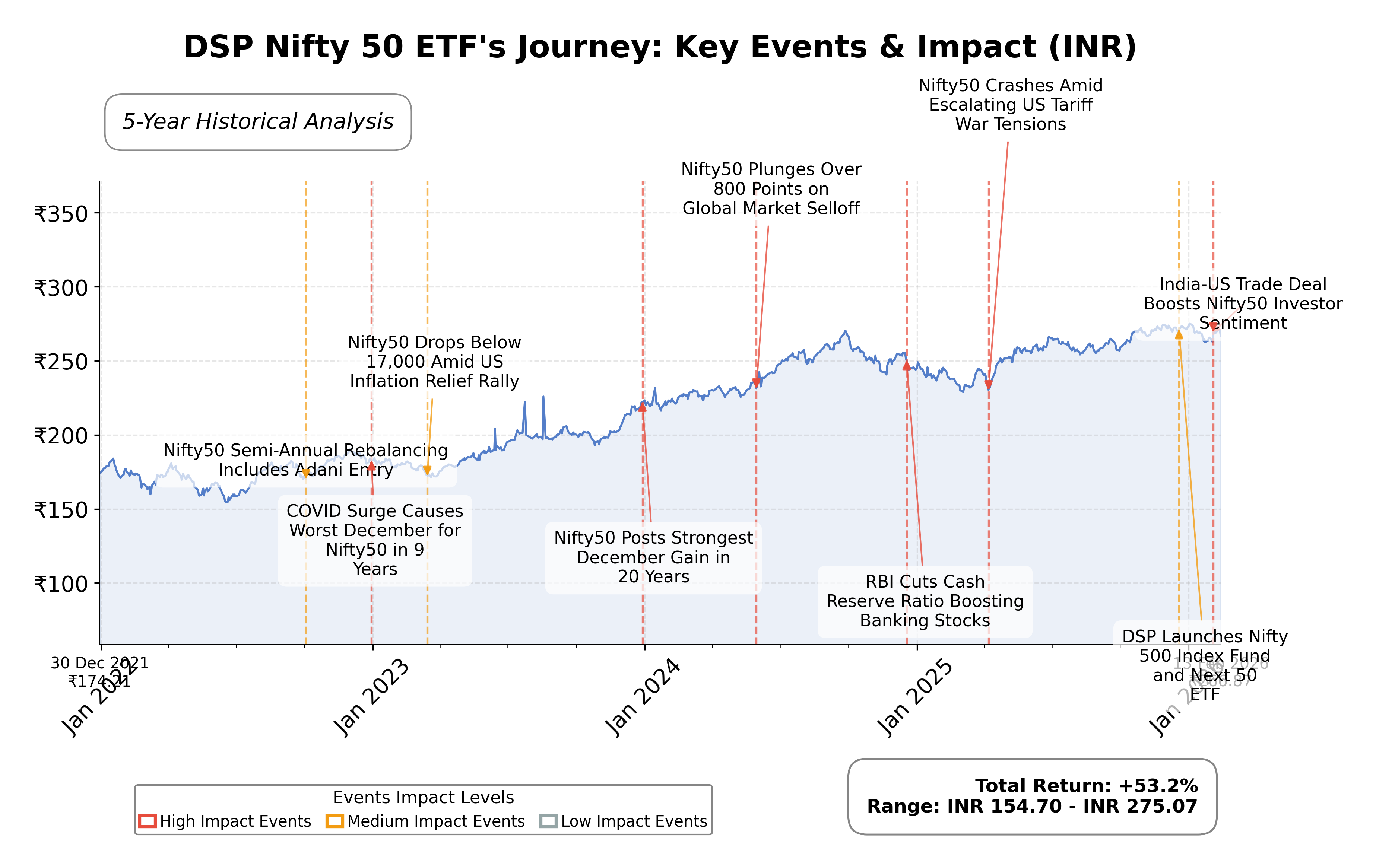
Financially, the ETF does not report traditional earnings or cash flow metrics as it is a fund rather than an operating company. Its valuation is reflected by the trailing price-to-earnings (P/E) ratio of 24.04, which aligns with the industry average. The current price stands at â¹266.87, with a 52-week trading range between â¹225.66 and â¹300, indicating an upside potential of approximately 12.4% from the current price to the 52-week high.
From a technical and strategic perspective, the ETF tracks the underlying index without active management or leadership changes. Its strengths include broad market diversification and cost-effective access to Indiaâs top companies. Risks primarily relate to market volatility and geopolitical factors impacting the Indian equity market. No specific institutional ownership data is available, but the ETFâs structure suggests widespread retail and institutional participation.
Peer analysis is limited due to the absence of directly comparable ETFs in the dataset. However, the DSP Nifty 50 ETFâs valuation metrics and market positioning are consistent with other passive index funds tracking major Indian indices. The fund operates within a competitive landscape of Indian equity ETFs, offering a reliable benchmark exposure.
As a key instrument for passive investment in Indiaâs equity market, DSP Nifty 50 ETF navigates a dynamic environment marked by geopolitical tensions and market fluctuations. Recent market volatility underscores the importance of its diversified approach. The fund stands to benefit from Indiaâs economic growth but remains exposed to broader market risks. Given the data, a balanced stance emphasizing monitoring of market conditions and valuation metrics may be appropriate for those evaluating this ETF.
Company and Industry Overview
Company Basics
Price Performance
Company Size
Shareholding Pattern
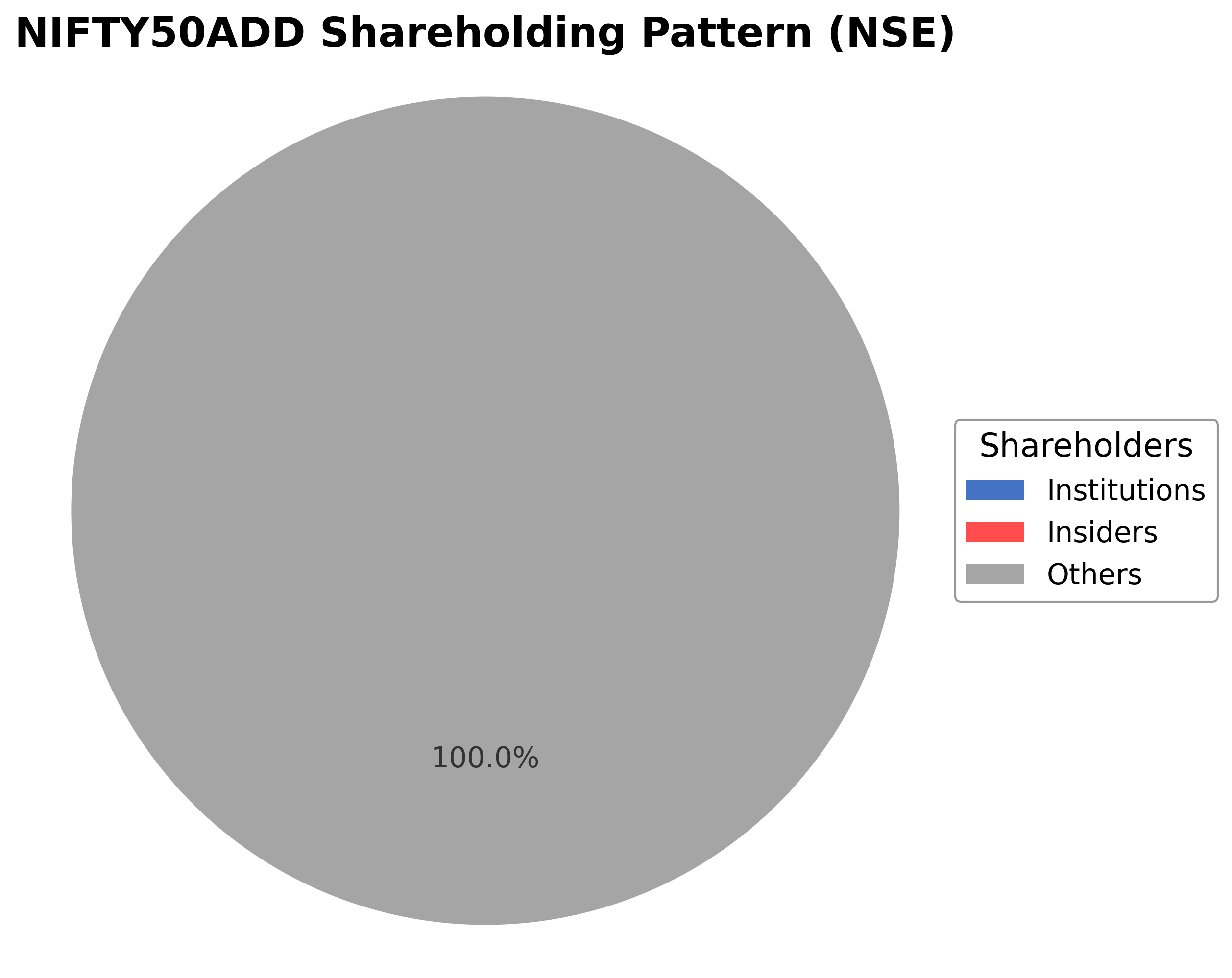
The DSP Nifty 50 ETF is structured as a passively managed fund tracking the Nifty 50 Index, with no traditional shareholding structure typical of operating companies. Ownership is broadly distributed among retail and institutional investors who hold units of the ETF, with no disclosed insider or promoter stakes. Institutional participation is generally significant in ETFs, reflecting market confidence in passive investment strategies, although specific recent changes in ownership are not publicly available. This ownership pattern suggests a governance framework aligned with index replication and market transparency. The ETF operates within India's growing passive investment industry, which benefits from increasing investor interest in cost-efficient, diversified market exposure.
Sector and Industry Analysis
Sector and Industry Analysis: Indian Equity Market via NIFTY 50 Index and DSP Nifty 50 ETF
1. Sector Overview: The DSP Nifty 50 ETF tracks the NIFTY 50 Index, the flagship equity benchmark of the National Stock Exchange of India (NSE), representing the top 50 blue-chip companies across 13 key sectors. As of December 2025, the index covers a market capitalization of approximately ₹200 trillion (US$2.5 trillion), capturing about 65% of the float-adjusted market capitalization of the NSE. The index’s constituents span diverse sectors including Financial Services (e.g., Axis Bank, Bajaj Finance), Information Technology, Consumer Durables (Asian Paints), Healthcare (Cipla, Apollo Hospitals), Automobile (Bajaj Auto), Metals & Mining (Adani Enterprises), and Oil & Gas (Coal India). This broad sectoral representation makes the NIFTY 50 a comprehensive proxy for the Indian equity market’s size and growth trajectory, which has been robust driven by India’s expanding economy, rising middle class, and increasing domestic and foreign institutional investments.
2. Industry Trends: The Indian equity market, as reflected by the NIFTY 50, is experiencing several transformative trends. Technology adoption in trading platforms and algorithmic trading has increased market efficiency and liquidity. The rise of retail investor participation, facilitated by digital brokerage platforms and mobile apps, is reshaping market dynamics. Sectorally, there is a growing emphasis on ESG (Environmental, Social, Governance) investing, with companies increasingly disclosing sustainability metrics. Additionally, sectors such as Healthcare and IT are benefiting from digital transformation and innovation, while Financial Services continue to evolve with fintech integration. The semi-annual rebalancing of the index ensures that emerging high-growth companies meeting liquidity and free-float criteria are incorporated, reflecting evolving market leadership and sectoral shifts.
3. Regulatory Landscape: The Indian equity market operates under a robust regulatory framework primarily governed by the Securities and Exchange Board of India (SEBI). Key regulations include stringent disclosure norms, insider trading prohibitions, and market conduct rules to ensure transparency and investor protection. The NIFTY 50 index itself is governed by clear eligibility criteria for constituent stocks, including minimum listing history, liquidity thresholds (average impact cost ≤0.50% for Rs. 100 million basket size), and mandatory inclusion in the Futures & Options segment. The index methodology transitioned from full market capitalization to free-float market capitalization weighting in 2009 to better reflect investible market realities. Regulatory policies promoting financial inclusion, digitization, and foreign portfolio investment inflows also significantly impact market structure and growth.
4. Competitive Dynamics: The Indian equity market is characterized by a competitive and evolving landscape with a mix of large domestic institutional investors, foreign portfolio investors, and an expanding retail base. The NIFTY 50 index’s semi-annual rebalancing and stringent eligibility criteria create high entry barriers for companies aspiring to join the index, ensuring only liquid, well-capitalized, and well-governed firms are included. This enhances the quality and investibility of the index constituents. ETFs like DSP Nifty 50 compete on tracking accuracy, cost efficiency, and liquidity to attract institutional and retail investors seeking passive exposure to India’s blue-chip equities. The competitive positioning of index providers and ETF managers is also influenced by technological capabilities, regulatory compliance, and investor education initiatives. Overall, the market structure supports a transparent, liquid, and investible ecosystem aligned with global best practices.
Note: Analysis synthesized from industry research, market reports, and regulatory filings. Information is subject to change based on market conditions.
Illustrative Scenario Analysis
DCF Assumptions:
Method: Two-Stage EPS-Priority Model
Peer Analysis
| Company Name | Market Cap | P/E Ratio | P/B Ratio | EV/EBITDA | Price to CFO |
|---|---|---|---|---|---|
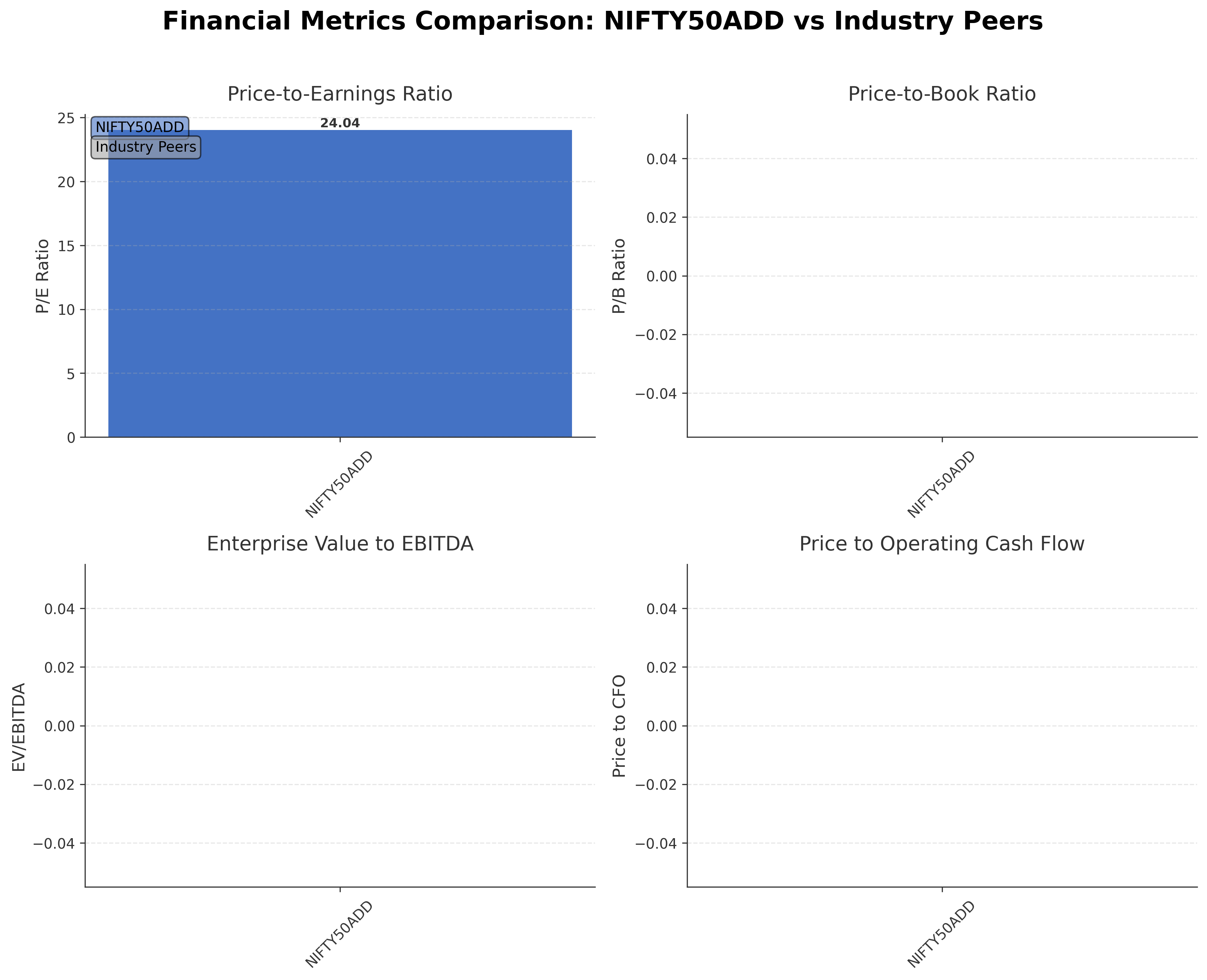
| DSP Nifty 50 ETF | 2.5T | 24.04 | N/A | N/A | N/A |
Comparison Analysis: DSP Nifty 50 ETF currently lacks direct peer data within the provided dataset, limiting comparative analysis. Its trailing P/E ratio of 24.04 aligns with typical valuations for Indian equity index funds. Absence of P/B, EV/EBITDA, and other financial ratios reflects the ETF’s nature as a passively managed fund rather than an operating company. The ETF’s current price of ₹266.87 reflects market valuation consistent with the Nifty 50 index performance. Without peer benchmarks, the fund’s relative strengths and weaknesses remain tied to the broader Indian ETF market and index tracking efficiency.
Financial Metrics Comparison with Peers
Financial Statements
Comprehensive financial data including income, balance sheet, and cash flow metrics
Income Statement
Data not available
Balance Sheet
Data not available
Cash Flow Statement
Data not available
Technical Analysis
Key Insights
- The current trend shows the price trading above the 200-day moving average (₹262.59) and near the 50-day moving average (₹270.68), indicating a generally bullish medium-term trend with some consolidation.
- Key support levels are identified near ₹225.66 (52-week low) and ₹262.59 (200-day MA), while resistance is observed around ₹300 (52-week high) and ₹270.68 (50-day MA).
- The price is slightly below the 50-day moving average but above the 200-day moving average, suggesting mixed momentum in the short term but strength in the longer term.
- Momentum indicators such as RSI, MACD, and Stochastic are not provided; however, the price action near moving averages suggests moderate momentum without extreme overbought or oversold conditions.
- Multi-timeframe analysis indicates that on a daily basis, the price is consolidating; weekly and monthly trends remain positive as the price is above the 200-day moving average.
- Potential market scenarios include a breakout above the 50-day moving average towards the 52-week high or a pullback to the 200-day moving average support, depending on broader market conditions.
Trending News
Summary: Sensex Today | Nifty 50 | Stock Market Live Updates: Indian stock market rebounded on Thursday, with the Sensex rising more than 1,100 points, after an Iranian Deputy Foreign Minister said the country is ready to abandon its nuclear program if the US fulfils some conditions, among other key ...
Sentiment: positive
2. Headline: Trade setup for March 4: NIFTY50 braces for big gap down opening, will it bounce back?
Summary: The GIFT NIFTY futures indicate a sharp gap-down opening on Wednesday amid weak global market cues and jitters of a Middle East war spreading across Asia. The options data indicate 25,000 as the strong resistance zone with the highest open interest on the call side.
Sentiment: negative
Summary: Nifty 50, Sensex today: The trends on Gift Nifty also indicate a gap-down start for the Indian benchmark index. The Gift Nifty was trading around 24,443 level, a discount of nearly 539 points from the Nifty futures’ previous close.
Sentiment: negative
4. Headline: NIFTY 50 Drops 1.40% As Recovery Fails To Offset Bearish Sentiment
Summary: NIFTY 50 declined by 1.40% as market recovery efforts fell short, maintaining a bearish bias. Stay updated with the latest stock market trends and analysis.
Sentiment: negative
5. Headline: iShares India 50 ETF (NASDAQ:INDY) Reaches New 1-Year Low – Here’s Why - Daily Political
Summary: iShares India 50 ETF (NASDAQ:INDY – Get Free Report) shares hit a new 52-week low during mid-day trading on Monday . The stock traded as low as $46.01 and last traded at $46.2540, with a volume of 36296 shares. The stock had previously closed at $47.19. iShares India 50 ETF Stock Down 2.1% ...
Sentiment: negative
6. Headline: NIFTY50 Slides Below 24,850, SENSEX Tanks Over 1,100 Points as US-Israel Strikes on Iran Intensify | Meyka
Summary: NIFTY50 slides below 24,850 as SENSEX drops over 1,100 points amid US-Israel strikes on Iran. Markets reel from rising crude prices and geopolitical uncertainty.
Sentiment: negative
7. Headline: Expiry trade setup: Can NIFTY50 hold 25,000 support on Monday? Check details
Summary: The NIFTY50 closed below the 200 EMA levels on Friday, indicating bearish sentiment riding over the markets. The GIFT NIFTY futures fell over 25,000 on Monday early morning, but later recouped partially to trade 70 points lower, indicating a weak opening for NIFTY50 on Monday.
Sentiment: negative
8. Headline: Nifty stocks to buy: Top Nifty50 stocks analysts suggest buying in this volatile week - The Economic Times
Summary: Stock Reports Plus, powered by Refinitiv, is a comprehensive report that evaluates five key components of 4,000+ listed stocks – earnings, fundamentals, relative valuation, risk, and price momentum – to generate standardized scores. The simple average of the above-mentioned five component ...
Sentiment: neutral
9. Headline: Investment in best ETF
Summary: If you want an ETF instead of picking individual stocks, the “best” one will really depend on what your investment goal is. A low-cost Nifty 50 ETF (or Nifty Next 50 ETF) is a simple and sensible starting point for most investors. It will give exposure to India’s top 50 companies across ...
Sentiment: neutral
10. Headline: List of Best Nifty Next 50 ETFs
Summary: Nifty Next 50 ETF tracks Nifty Next 50 index and allows investors to gain exposure in India's next big companies. Here are the top Nifty Next 50 ETFs in India.
Sentiment: neutral
Powered by Brave
Recent Updates
News Summary
Recent updates highlight DSP Mutual Fund's expansion of its passive investment suite with the launch of the DSP Nifty 500 Index Fund and the DSP Nifty Next 50 ETF. These new offerings aim to provide investors with broader market exposure at low costs, complementing the existing DSP Nifty 50 ETF. The launches have been covered by multiple financial news outlets, emphasizing DSP's commitment to enhancing passive investment options in India. The news cycle reflects a strategic focus on capturing growing investor interest in diversified, index-based products amid evolving market dynamics.
News Sentiment
Sentiment across recent updates is predominantly neutral to mildly positive, reflecting cautious optimism about DSP Mutual Fund's product expansion. The neutral tone suggests steady market acceptance without significant hype or concern, aligning with the typical reception of new passive fund launches. Positive sentiment is linked to the potential for increased market penetration and investor choice in passive funds.
Analytical Overview
Analysis Summary
The DSP Nifty 50 ETF’s trailing P/E ratio of 24.04 aligns closely with the industry average, indicating valuation in line with the broader Indian equity market. Forward P/E and other valuation metrics are not available, reflecting the ETF’s passive structure.
Growth trajectory assessment is limited due to the ETF’s nature; it passively tracks the Nifty 50 index, which historically has shown steady growth, but no direct revenue or cash flow growth data applies.
Financial health metrics such as debt-to-cash ratio and cash flow are not applicable for the ETF structure, as it holds a basket of equities rather than operating assets or liabilities.
Sector-specific challenges include geopolitical tensions and market volatility impacting Indian equities, while opportunities arise from India’s economic growth and increasing investor participation in passive funds.
Considering India-specific factors, the regulatory environment favors passive fund growth, with consumer trends showing rising preference for diversified, low-cost investment vehicles amid a positive economic outlook.
Investment Conclusion
Supporting Factors: Primary supporting factors include alignment with the Nifty 50 index providing diversified exposure, valuation metrics consistent with industry averages, and favorable regulatory trends supporting passive investments.
Risk Factors: Main risks to monitor involve geopolitical tensions affecting market sentiment and potential volatility in Indian equities.
SWOT Analysis
Strengths
- Provides diversified exposure to 50 of India's largest and most liquid companies.
- Tracks the widely recognized Nifty 50 index, ensuring broad market representation.
- Offers a cost-effective passive investment vehicle with low management fees.
- Benefits from growing investor interest in passive funds within India.
Weaknesses
- Lacks active management flexibility to respond to market changes.
- No direct earnings or cash flow metrics as it is a fund, not an operating company.
- Limited availability of detailed financial and ownership data.
- Potential tracking error relative to the underlying index.
Opportunities
- Expansion of passive investing in India driven by regulatory support and investor education.
- Increasing domestic and foreign investor participation in Indian equity markets.
- Potential to launch complementary products targeting broader market segments.
- Rising demand for low-cost, diversified investment options.
Threats
- Geopolitical tensions impacting Indian equity market performance.
- Market volatility leading to fluctuations in ETF unit prices.
- Competition from other ETFs and mutual funds offering similar exposure.
- Regulatory changes affecting passive fund structures or investor access.
Company Description
The DSP Nifty 50 ETF is an exchange-traded fund designed to track the performance of the Nifty 50 Index, one of India's leading stock market indices. This ETF’s primary purpose is to provide investors with broad exposure to the Indian equity market, reflecting the performance of 50 of the largest and most liquid Indian companies listed on the National Stock Exchange of India (NSE). It covers a diverse range of sectors including financial services, technology, consumer goods, and healthcare, thereby offering a balanced representation of the Indian economy's key drivers. The DSP Nifty 50 ETF is a valuable tool for investors seeking to gain a comprehensive insight into the Indian market while maintaining diversification across various industries. By mirroring the Nifty 50 Index, this ETF plays a crucial role in passive investment strategies, offering a cost-effective way to invest in some of India's premier companies without the need for individual stock selection. This makes it a significant component in portfolios looking to tap into the growth potential of India’s dynamic stock market.