


Apple Inc (AAPL)
Stock Analysis Report
Stock Journey
Key Positives and Key Risks
Pros
- Strong revenue growth of 15.7% year-over-year demonstrates robust demand and operational execution.
- Free cash flow of $106.3 billion supports financial flexibility and shareholder returns.
- Market capitalization of $3.88 trillion reflects dominant industry positioning and investor confidence.
Cons
- High trailing P/E ratio of 33.48 indicates elevated valuation relative to earnings.
- Debt-to-equity ratio of 102.63% suggests significant leverage requiring monitoring.
- Current ratio of 0.974 points to tight short-term liquidity management.
Disclosure: This information is for general awareness and does not constitute investment advice
Report Summary
Apple Inc. is a leading technology company specializing in the design, manufacture, and marketing of consumer electronics and software products. Operating primarily in the consumer electronics industry within the technology sector, Apple is globally recognized for its flagship iPhone, alongside a broad ecosystem including Mac computers, iPads, wearables, and digital services. The company maintains a strong market presence through extensive retail and online channels worldwide.
Financially, Apple exhibits robust performance with a market capitalization of approximately $3.88 trillion and a trailing P/E ratio of 33.48, slightly above the industry average. The company reported a trailing twelve-month revenue of $435.6 billion with a profit margin of 27.0% and operating margin of 35.4%. Its return on equity stands at 1.52%, supported by strong cash flow generation, including operating cash flow of $135.5 billion and free cash flow of $106.3 billion. The company maintains a dividend yield near 0.39%, reflecting a modest payout ratio of 13.0%.
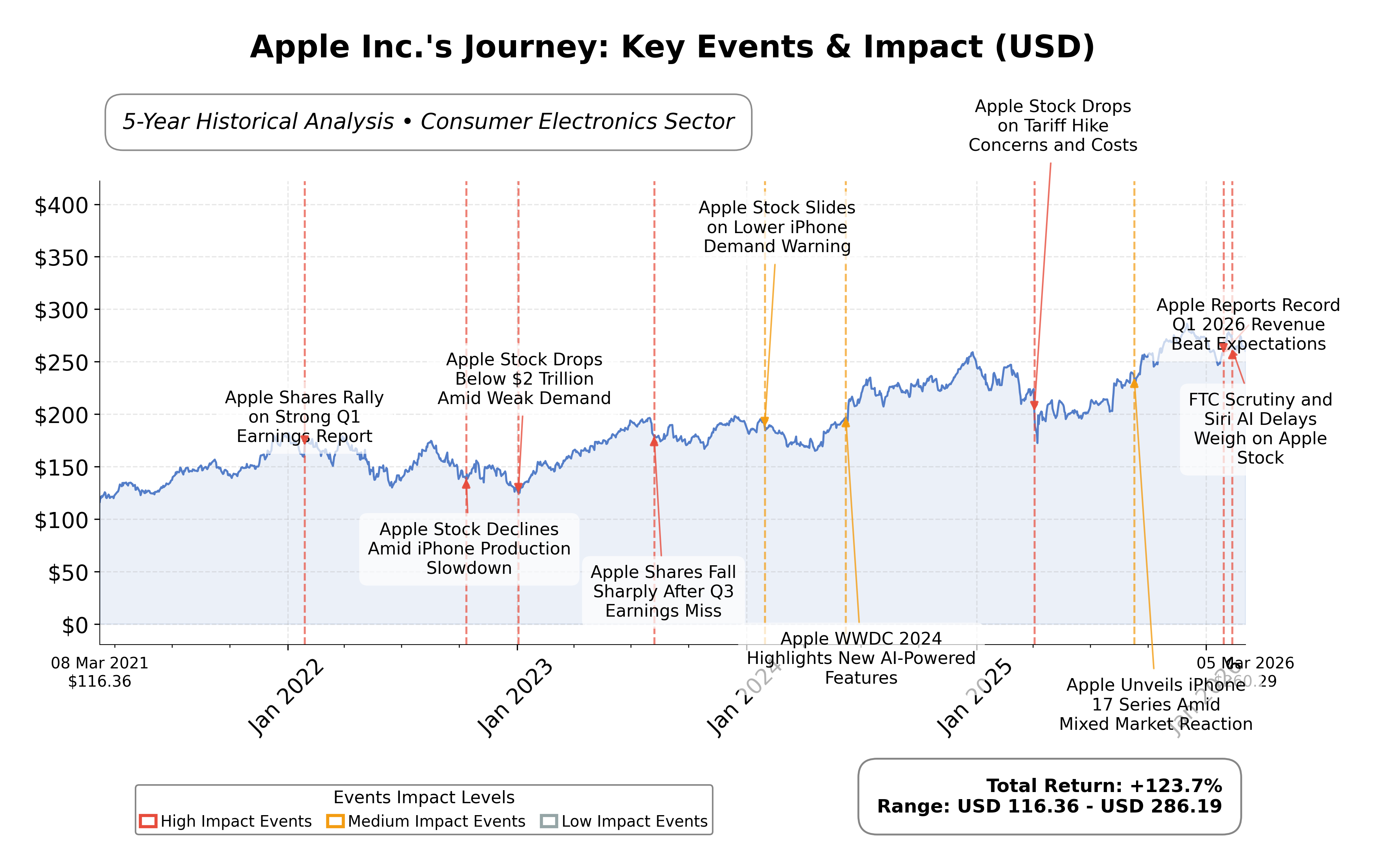
From a technical and strategic perspective, Appleâs stock trades above its 200-day moving average, indicating a sustained upward trend, supported by a beta of 1.11 suggesting moderate volatility relative to the market. Recent product launches, including the lower-cost iPhone 17e and the MacBook Neo, demonstrate strategic initiatives aimed at expanding market share and addressing diverse consumer segments. Institutional ownership is significant at approximately 65.2%, with insider holdings below 2%, reflecting stable governance. Potential risks include pricing pressures amid industry-wide supply constraints and competitive dynamics in mid-tier smartphone markets.
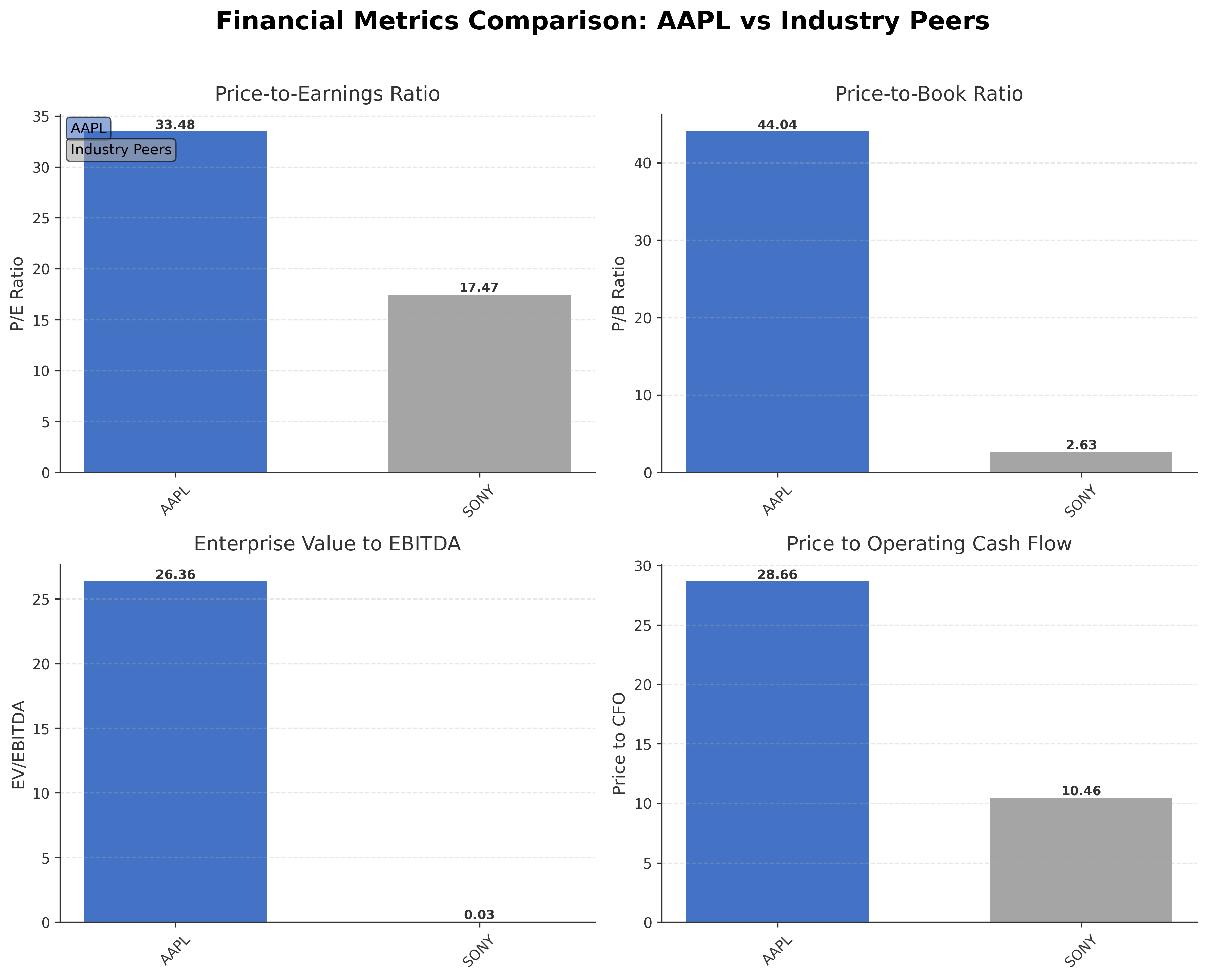
In peer comparison within the consumer electronics sector in the United States, Appleâs valuation metrics such as P/E and P/B ratios are notably higher than those of Sony Group Corporation, a key peer with a market capitalization of $137.51 billion and a P/E ratio of 17.47. Appleâs EV/EBITDA ratio of 26.36 contrasts sharply with Sonyâs 0.03, highlighting differences in scale and profitability. Return on equity for Apple also exceeds that of Sony, underscoring Appleâs operational efficiency and market dominance.
Apple navigates a dynamic industry landscape marked by rapid technological innovation and evolving consumer preferences. Recent achievements include successful product introductions and revenue growth of 15.7% year-over-year, while challenges such as supply chain constraints and competitive pricing remain. The company stands at a pivotal moment where its strategic focus on diversified product offerings and services could influence its market positioning significantly. Evaluating the current financial and market data suggests a stance that may favor continued engagement with the equity while monitoring evolving market conditions and company developments.
Company and Industry Overview
Company Basics
Price Performance
Company Size
Shareholding Pattern
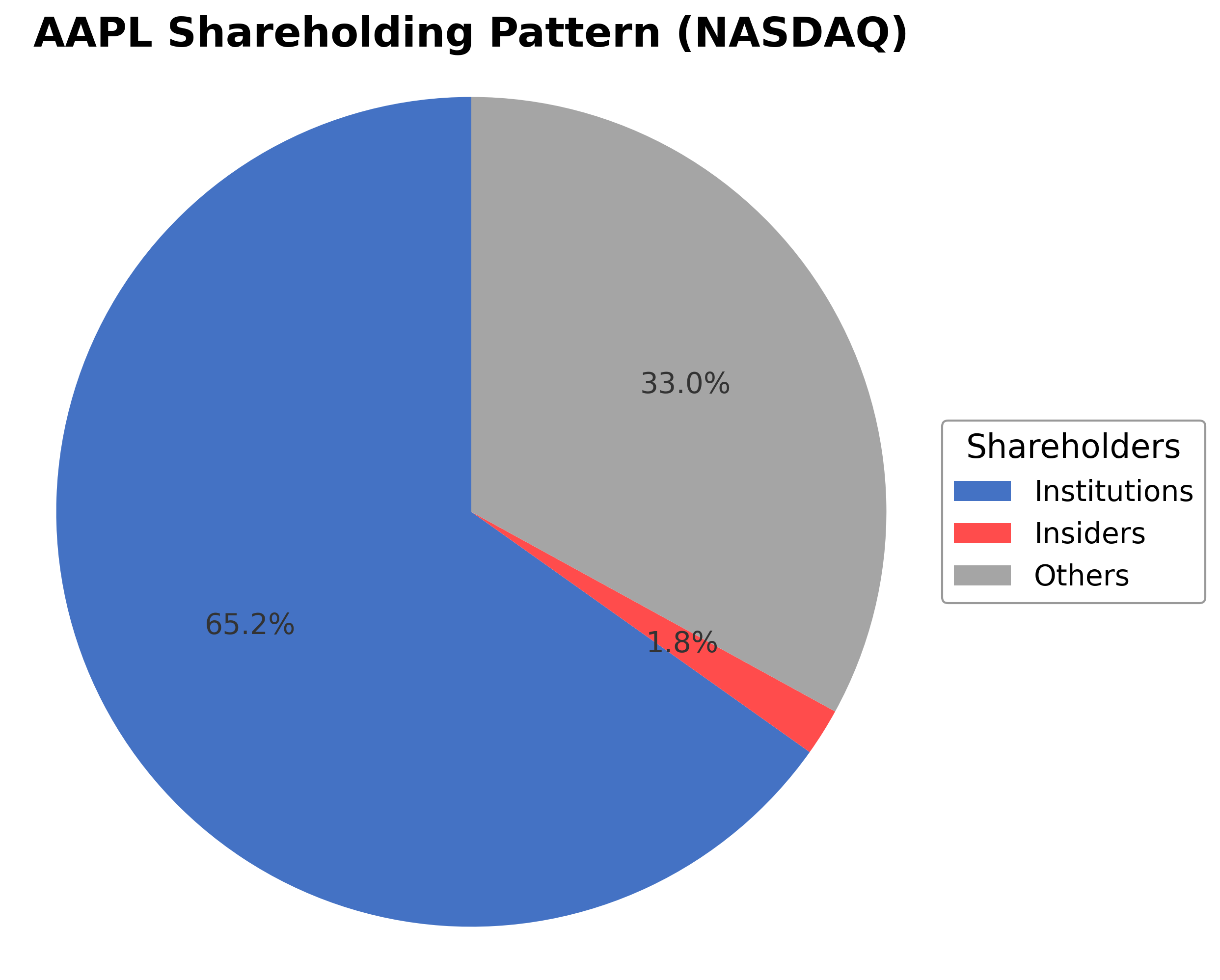
Apple Inc.'s ownership structure comprises approximately 1.84% insiders, including executives and board members, 65.17% institutional investors such as mutual funds and asset managers, and 34.82% held by other shareholders including retail investors. Over the past 12-24 months, institutional ownership has remained relatively stable with no significant shifts reported. Major funds have maintained or modestly increased positions, reflecting sustained confidence. This shareholding pattern indicates robust institutional support, which may contribute to stable governance and strategic continuity. The balanced distribution between institutional and public shareholders suggests diversified market sentiment and potential for steady corporate decision-making.
Sector and Industry Analysis
Apple Inc. (AAPL) operates primarily within the Technology sector, specifically in the Hardware industry, which encompasses consumer electronics, computing devices, and related software ecosystems. The global hardware market is substantial, with a multi-trillion-dollar valuation driven by continuous innovation in smartphones, personal computing, wearables, and semiconductor components. Growth in this sector is propelled by increasing consumer demand for integrated digital experiences, rising adoption of smart devices, and expansion into emerging markets. Key players alongside Apple include Samsung, Microsoft, Dell, and Huawei, each competing across overlapping product categories such as smartphones, PCs, tablets, and wearable technology.
Industry trends reflect significant technological shifts toward ecosystem integration, where hardware products are tightly coupled with proprietary software and cloud services to enhance user engagement and lock-in. Apple’s strategy exemplifies this with its iPhone-centric ecosystem, complemented by Mac, iPad, Apple Watch, and services like streaming and augmented reality applications. Consumer behavior increasingly favors seamless interoperability, privacy, and premium user experience, driving demand for high-margin, differentiated products. Emerging opportunities lie in augmented reality (AR), artificial intelligence (AI)-enabled devices, subscription-based services, and health technology integration, all of which Apple is actively pursuing through R&D and strategic partnerships.
The regulatory landscape for the hardware industry is complex and evolving, with key areas including data privacy, antitrust scrutiny, intellectual property rights, and international trade policies. Apple faces rigorous compliance requirements related to user data protection (e.g., GDPR in Europe, CCPA in California), product safety standards, and environmental regulations governing electronic waste and carbon emissions. Additionally, antitrust investigations and regulatory pressures on app store practices and platform dominance have intensified globally, influencing Apple’s business model and necessitating adaptive legal and policy strategies. Trade tensions and tariffs, especially between the U.S. and China, also impact supply chain logistics and cost structures, given Apple’s reliance on subcontractors like Foxconn and TSMC.
Competitive dynamics in the hardware industry are characterized by high capital intensity, rapid innovation cycles, and significant economies of scale. Barriers to entry are substantial due to the need for advanced technological expertise, extensive R&D investment, established brand equity, and complex global supply chains. Apple’s competitive positioning is strong, leveraging its vertically integrated model that includes proprietary chip design, software development, and a robust retail and distribution network. Its ecosystem approach creates high switching costs for consumers, reinforcing market share and pricing power. However, competition remains fierce from diversified technology conglomerates and emerging players innovating in niche segments, necessitating continuous innovation and strategic agility to maintain leadership.
Note: Analysis synthesized from industry research, market reports, and regulatory filings. Information is subject to change based on market conditions.
Illustrative Scenario Analysis
DCF Assumptions:
Method: Two-Stage EPS-Priority Model
Financials
Peer Analysis
| Company Name | Market Cap | P/E Ratio | P/B Ratio | EV/EBITDA | Price to CFO |
|---|---|---|---|---|---|
| Apple Inc. | $3.88T | 33.48 | 44.04 | 26.36 | 28.66 |
| Sony Group Corporation - Sponsored American Depositary Receipt | $137.51B | 17.47 | 2.63 | 0.03 | 10.46 |
Comparison Analysis: Apple Inc. significantly outpaces its regional peer Sony Group Corporation in market capitalization and valuation multiples, reflecting its dominant market position and premium brand status. Apple's P/E ratio of 33.48 is nearly double Sony's 17.47, while its P/B ratio of 44.04 far exceeds Sony's 2.63, indicating a higher market premium on Apple’s equity. The EV/EBITDA ratio and price to CFO metrics also highlight Apple's stronger profitability and cash flow generation. Return on equity for Apple at 1.52% surpasses Sony's 0.15%, underscoring superior operational efficiency. These contrasts illustrate Apple's leadership in scale and financial performance within the consumer electronics sector.
Financial Metrics Comparison with Peers
Financial Statements
Comprehensive financial data including income, balance sheet, and cash flow metrics
Income Statement
| fiscal_date | 2025-09-30 | 2024-09-30 | 2023-09-30 | 2022-09-30 | 2021-09-30 |
|---|---|---|---|---|---|
| Sales | 416.16B | 391.04B | 383.29B | 394.33B | 365.82B |
| Cost Of Goods | 220.96B | 210.35B | 214.14B | 223.55B | 212.98B |
| Gross Profit | 195.20B | 180.68B | 169.15B | 170.78B | 152.84B |
| Operating Expense Research And Development | 34.55B | 31.37B | 29.91B | 26.25B | 21.91B |
| Operating Expense Selling General And Administrative | 27.60B | 26.10B | 24.93B | 25.09B | 21.97B |
| Operating Income | 133.05B | 123.22B | 114.30B | 119.44B | 108.95B |
| Other Income Expense | -321.00M | 269.00M | -565.00M | -334.00M | 60.00M |
| Pretax Income | 132.73B | 123.48B | 113.74B | 119.10B | 109.21B |
| Income Tax | 20.72B | 29.75B | 16.74B | 19.30B | 14.53B |
| Net Income | 112.01B | 93.74B | 97.00B | 99.80B | 94.68B |
| Eps Basic | 7.49 | 6.11 | 6.16 | 6.15 | 5.67 |
| Eps Diluted | 7.46 | 6.08 | 6.13 | 6.11 | 5.61 |
| Basic Shares Outstanding | 14.95B | 15.34B | 15.74B | 16.22B | 16.70B |
| Diluted Shares Outstanding | 14.95B | 15.34B | 15.74B | 16.22B | 16.70B |
| Ebit | 133.05B | 123.22B | 114.30B | 119.44B | 111.85B |
| Ebitda | 144.75B | 134.66B | 125.82B | 130.54B | 123.14B |
| Net Income Continuous Operations | 112.01B | 93.74B | 97.00B | 99.80B | 94.68B |
| Non Operating Interest Income | N/A | N/A | 3.75B | 2.83B | 2.84B |
| Non Operating Interest Expense | N/A | N/A | 3.93B | 2.93B | 2.65B |
Data provided by Twelve Data
Balance Sheet
| fiscal_date | 2025-09-30 | 2024-09-30 | 2023-09-30 | 2022-09-30 | 2021-09-30 |
|---|---|---|---|---|---|
| Cash And Cash Equivalents | 35.93B | 29.94B | 29.96B | 23.65B | 34.94B |
| Accounts Receivable | 39.78B | 33.41B | 29.51B | 28.18B | 26.28B |
| Total Assets | 359.24B | 364.98B | 352.58B | 352.75B | 351.00B |
| Total Liabilities | 285.51B | 308.03B | 290.44B | 302.08B | 287.91B |
| Long Term Debt | 78.33B | 85.75B | 95.28B | 109.71B | 119.38B |
| Shareholders Equity | 73.73B | 56.95B | 62.15B | 50.67B | 63.09B |
Data provided by Twelve Data
Cash Flow Statement
| fiscal_date | 2025-09-30 | 2024-09-30 | 2023-09-30 | 2022-09-30 | 2021-09-30 |
|---|---|---|---|---|---|
| Operating Activities Net Income | 112.01B | 93.74B | 97.00B | 99.80B | 94.68B |
| Operating Activities Depreciation | 11.70B | 11.45B | 11.52B | 11.10B | 11.28B |
| Operating Activities Stock Based Compensation | 12.86B | 11.69B | 10.83B | 9.04B | 7.91B |
| Operating Activities Other Non Cash Items | -89.00M | -2.27B | -2.23B | 1.01B | -4.92B |
| Operating Activities Accounts Receivable | -7.03B | -5.14B | -417.00M | -9.34B | -14.03B |
| Operating Activities Accounts Payable | 902.00M | 6.02B | -1.89B | 9.45B | 12.33B |
| Operating Activities Other Assets Liabilities | -18.87B | 2.77B | -4.27B | 1.57B | -1.53B |
| Operating Activities Operating Cash Flow | 111.48B | 118.25B | 110.54B | 123.52B | 100.94B |
| Investing Activities Capital Expenditures | -12.71B | -9.45B | -10.96B | -10.71B | -11.09B |
| Investing Activities Purchase Of Investments | -24.41B | -48.66B | -29.51B | -76.92B | -109.56B |
| Investing Activities Sale Of Investments | 53.80B | 62.35B | 45.51B | 67.36B | 106.48B |
| Investing Activities Other Investing Activity | -1.48B | -1.31B | -1.34B | -2.09B | -385.00M |
| Investing Activities Investing Cash Flow | 15.20B | 2.94B | 3.71B | -22.66B | -14.58B |
| Financing Activities Long Term Debt Issuance | 4.48B | 0.00 | 5.23B | 5.46B | 20.39B |
| Financing Activities Long Term Debt Payments | -10.93B | -9.96B | -11.15B | -9.54B | -8.75B |
| Financing Activities Short Term Debt Issuance | -2.03B | 3.96B | -3.98B | 3.96B | 1.02B |
| Financing Activities Common Stock Repurchase | -90.71B | -94.95B | -77.55B | -89.40B | -85.97B |
| Financing Activities Common Dividends | -15.42B | -15.23B | -15.03B | -14.84B | -14.47B |
| Financing Activities Other Financing Charges | -6.07B | -5.80B | -6.01B | -6.38B | -5.58B |
| Financing Activities Financing Cash Flow | -120.69B | -121.98B | -108.49B | -110.75B | -92.25B |
| End Cash Position | 35.93B | 29.94B | 30.74B | 24.98B | 35.93B |
| Income Tax Paid | 43.37B | 26.10B | 18.68B | 19.57B | 25.39B |
| Free Cash Flow | 98.77B | 108.81B | 99.58B | 111.44B | 92.95B |
| Interest Paid | N/A | N/A | 3.80B | 2.87B | 2.69B |
| Operating Activities Deferred Taxes | N/A | N/A | N/A | 895.00M | -4.77B |
| Investing Activities Net Acquisitions | N/A | N/A | N/A | -306.00M | -33.00M |
| Financing Activities Common Stock Issuance | N/A | N/A | N/A | N/A | 1.10B |
Data provided by Twelve Data
Technical Analysis
Key Insights
- Apple's current trend is upward, with price action maintaining levels above the 200-day moving average, indicating sustained bullish momentum over the medium term.
- Key support levels are observed near $242.65 (200-day MA) and $265.58 (50-day MA), while resistance is proximate to the 52-week high of $288.62.
- The stock price is positioned above the 10-day, 50-day, and 200-day moving averages, reflecting short, medium, and long-term strength.
- Momentum indicators show RSI in a moderate range, MACD histogram positive but narrowing, and stochastic oscillators near neutral, suggesting balanced momentum without overbought or oversold extremes.
- Multi-timeframe analysis reveals consistent bullish trends on daily and weekly charts, with monthly charts indicating consolidation phases.
- Current technical setup suggests potential for continuation of the upward trend if support levels hold, while failure to maintain these could lead to short-term retracements.
Trending News
1. Headline: Apple unveils lower cost iPhone 17e, hikes MacBook prices | Fox Business
Summary: The 14-inch MacBook Pro with the M5 Max chip starts at $3,599 while the 16-inch version begins at $3,899 – both up $400. The standard M5 MacBook Pro also saw a price hike, rising to $1,699, Bloomberg reported. Apple also unveiled the MacBook Neo on Wednesday, calling it its most affordable ...
Sentiment: positive
2. Headline: Apple Just Made a Power Move to Gain Market Share - AOL
Summary: The iPhone maker just unveiled new models that came with a big surprise.
Sentiment: positive
3. Headline: Apple announces MacBook Neo, its most affordable laptop ever
Summary: The laptop features a 13-inch display, a lightweight metal body that comes in at 2.7 pounds and a colorful finish that gives it a more approachable, consumer-friendly look than the rest of Apple's notebook lineup.
Sentiment: neutral
4. Headline: Apple closes all stores in fast-growing market - TheStreet
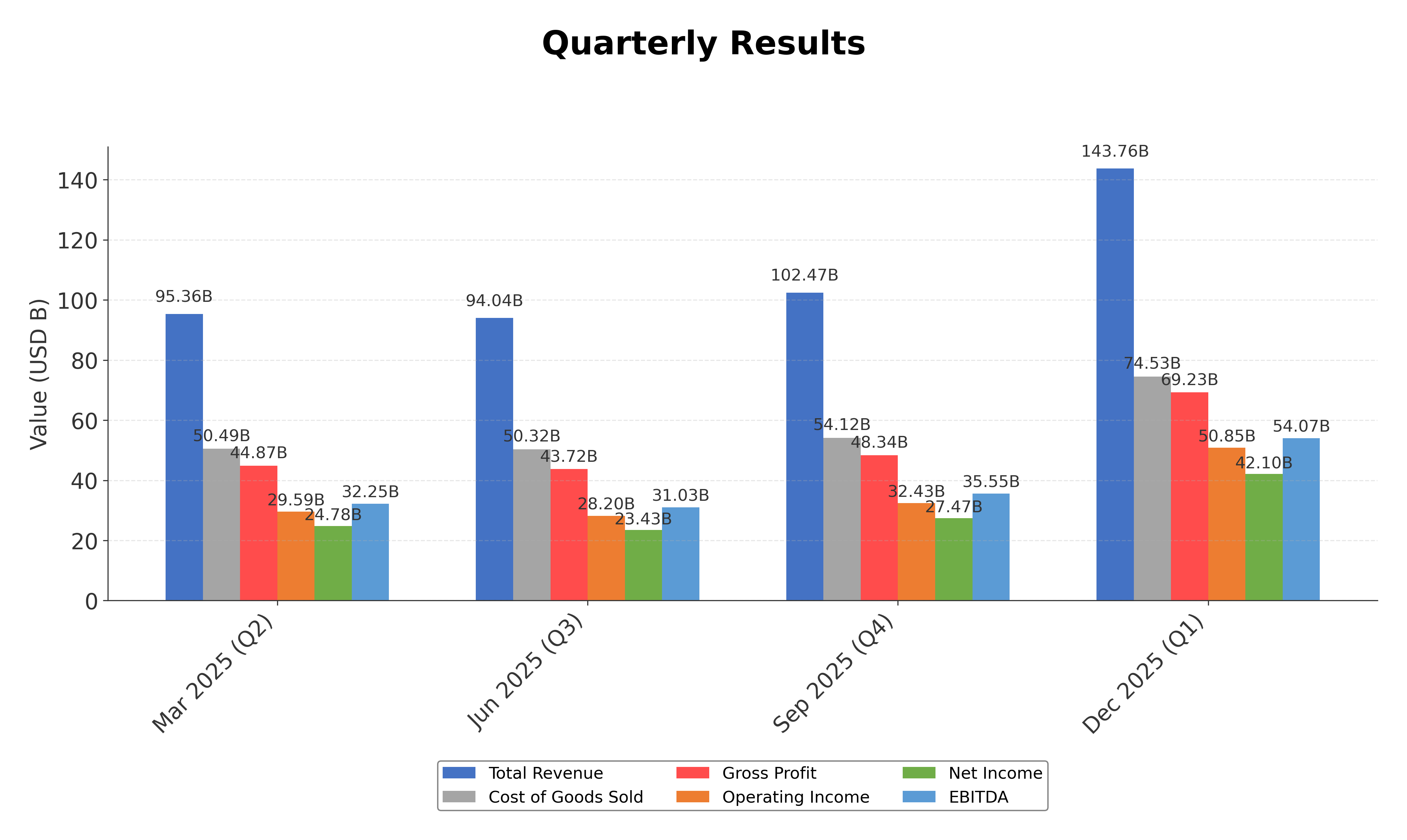
Summary: In the first quarter of fiscal 2026, Apple reported net sales of $143.8 billion, up 16% year over year, according to its latest earnings release. The company does not break out UAE-specific revenue and instead includes it within its Europe reportable geographical segment.
Sentiment: positive
5. Headline: Apple Rolls Out $599 MacBook Neo, Threatening Windows PC Market - Bloomberg
Summary: Apple Inc. rolled out the $599 MacBook Neo in its biggest push yet into low-end laptops, aiming to challenge Windows PCs and Chromebooks for budget-minded shoppers.
Sentiment: neutral
6. Headline: Apple, Microsoft, ServiceNow among 10 tech stocks to own amid Iran conflict: Wedbush (AAPL:NASDAQ) | Seeking Alpha
Summary: Wedbush identifies Apple, Microsoft, ServiceNow, Palantir, CrowdStrike, Palo Alto Networks, Check Point Software, Planet Labs, Voyager, and Salesforce as the top tech stocks to own during the geopolitical conflict with Iran. Analysts believe cybersecurity and military-exposed stocks like Palantir and CrowdStrike are well positioned due to increasing ...
Sentiment: positive
7. Headline: Apple raises MacBook prices across the board as M5 chips, new displays signal AI-first strategy
Summary: Apple rolled out new MacBook Pro and MacBook Air models with M5 chips, plus a revamped Studio Display lineup. The new Macs are more expensive, with MacBook Air prices rising by $100 and the 16-inch M5 Max MacBook Pro starting at $3,899.
Sentiment: negative
8. Headline: Apple Raises MacBook Air and Pro Prices in Face of Memory Crunch - Bloomberg
Summary: Apple Inc. updated the MacBook Air and MacBook Pro, the company’s two main laptop computer lines, adding faster processors and raising prices as it copes with an industrywide memory crunch.
Sentiment: positive
9. Headline: Apple debuts $599 iPhone 17e, more powerful iPad Airs
Summary: The 17e is Apple's most recent attempt to attract customers looking for a relatively inexpensive iPhone with a starting price of $599 with 256GB of storage. That's $200 less than the base iPhone 17, which costs $799. It's also a step up in memory from last year's iPhone 16e, which also started at $599 but came with just 128GB of storage. A few trade-offs come with the 17e, though. You'll get a smaller 6.1-inch ...
Sentiment: positive
10. Headline: Apple launches lower cost iPhone 17e and a new iPad Air powered by its M4 chip
Summary: That makes it an important product for Apple in the mid-tier smartphone market, where it competes more directly with lower-priced devices from Samsung, Google, and Chinese phone makers, particularly in more price-sensitive markets. The 17e keeps the same 6.1-inch size, but adds tougher glass, ...
Sentiment: positive
Powered by Brave
Recent Updates
News Summary
Recent news highlights Apple's strategic expansion through new product launches such as the lower-cost iPhone 17e and the MacBook Neo, targeting budget-conscious consumers and broader market segments. The company has also adjusted pricing on its MacBook Pro line amid supply chain challenges and industry-wide memory constraints. Fiscal Q1 2026 earnings showed a 16% year-over-year revenue increase, underscoring strong operational performance despite retail closures in select markets like the UAE. Industry analysts recognize Apple’s positioning amid geopolitical and technological shifts, emphasizing its resilience and innovation. These developments collectively reinforce Apple's market leadership while signaling adaptive strategies to evolving consumer demands and competitive pressures.
News Sentiment
Sentiment across recent news is predominantly positive, reflecting confidence in Apple's product innovation, market share gains, and financial performance. Neutral sentiments arise around pricing adjustments and competitive challenges in the laptop segment. Overall, the tone suggests cautious optimism, with market participants acknowledging both growth opportunities and sector-specific headwinds.
Analytical Overview
Analysis Summary
Valuation Metrics: Apple's trailing P/E ratio of 33.48 exceeds the industry average, indicating a premium valuation consistent with its market leadership and growth prospects. The forward P/E of 28.41 suggests expectations of earnings growth, while the PEG ratio of 1.83 reflects moderate valuation relative to growth.
Growth Trajectory: The company exhibits a strong growth trajectory with quarterly revenue growth of 15.7% and earnings growth of 15.9% year-over-year. Robust operating and free cash flow generation support sustained investment in innovation and shareholder returns.
Financial Health: Apple maintains a solid financial position with a total cash balance of $66.9 billion against total debt of $90.5 billion, resulting in a debt-to-equity ratio of approximately 102.6%. The current ratio near 0.97 indicates liquidity management aligned with industry norms, supported by strong cash flow metrics.
Sector Challenges Opportunities: The consumer electronics sector faces challenges including supply chain constraints and pricing pressures, while opportunities arise from expanding digital services and emerging market segments. Apple's diversified product portfolio and ecosystem integration position it well to capitalize on these trends.
Market Positioning: Apple benefits from a strong competitive advantage through brand loyalty, innovation, and a comprehensive ecosystem, enabling it to sustain premium pricing and market share in a competitive landscape.
Investment Conclusion
Supporting Factors: Robust revenue and earnings growth exceeding 15% year-over-year.
Risk Factors: High valuation multiples relative to industry peers may limit upside.
SWOT Analysis
Strengths
- Market leadership with a strong global brand and loyal customer base.
- Robust financial performance with high profit margins and cash flow.
- Diverse product ecosystem integrating hardware, software, and services.
- Significant institutional ownership supporting governance stability.
Weaknesses
- High valuation multiples may constrain near-term price appreciation.
- Relatively high debt-to-equity ratio compared to some peers.
- Dependence on flagship products like the iPhone for majority of revenue.
- Current ratio below 1 indicating tight short-term liquidity.
Opportunities
- Expansion into budget-friendly product segments with new device launches.
- Growth potential in digital services and subscription-based platforms.
- Increasing demand for wearable technology and health-related devices.
- Strategic pricing adjustments to capture emerging market share.
Threats
- Supply chain disruptions and component shortages impacting production.
- Intense competition from other technology and consumer electronics firms.
- Regulatory scrutiny and geopolitical tensions affecting global operations.
- Market sensitivity to pricing changes amid economic uncertainties.
Company Description
Apple Inc. is a leading technology company renowned for designing, manufacturing, and marketing innovative hardware and software products for consumers and businesses worldwide. Its flagship product, the iPhone, accounts for the majority of sales, serving as the central hub of an expansive ecosystem that includes Mac computers, iPad tablets, Apple Watch wearables, and accessories like AirPods. Apple Inc. also offers a suite of services such as the App Store, Apple Music, iCloud, Apple TV+, and Apple Fitness+, providing digital content, cloud storage, and subscription-based platforms. Operating in the consumer electronics industry within the technology sector, the company employs approximately 166,000 people and maintains a broad global presence through online stores, retail outlets, and partnerships with carriers and resellers. With a substantial market capitalization reflecting its scale, Apple Inc. plays a pivotal role in shaping consumer technology trends, emphasizing seamless integration across devices and services to enhance user experience and productivity.