


Apple Inc (AAPL)
Stock Analysis Report
Stock Journey
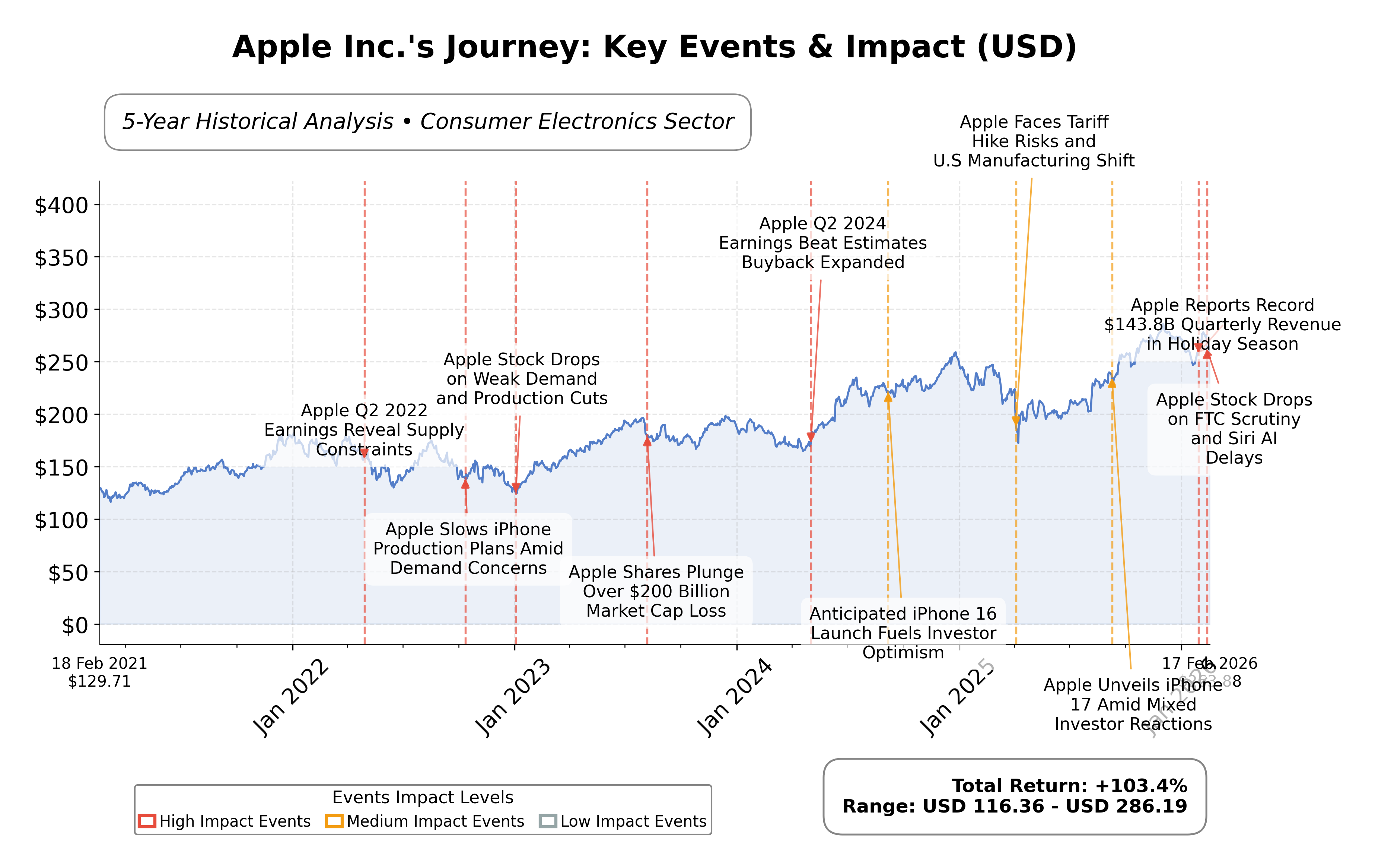
Key Positives and Key Risks
Pros
- Revenue growth of 15.7% year-over-year demonstrates strong top-line expansion supporting business momentum.
- Operating cash flow of $135.5 billion and free cash flow of $106.3 billion indicate robust cash generation capacity.
- Institutional ownership at 65.48% reflects significant confidence and governance stability among major shareholders.
Cons
- High price-to-book ratio of 42.64 suggests a premium valuation that may limit upside potential.
- Current ratio of 0.974 indicates tight liquidity, potentially constraining short-term financial flexibility.
- Recent removal of ESG modifiers from executive pay packages may raise concerns regarding sustainability commitments.
Disclosure: This information is for general awareness and does not constitute investment advice
Report Summary
Apple Inc. operates as a leading technology company specializing in the design, manufacturing, and marketing of consumer electronics and software products. Its core offerings include the iPhone, Mac computers, iPads, Apple Watch, and a suite of digital services such as the App Store and Apple Music. Positioned prominently within the consumer electronics industry, Apple maintains a significant global presence and a substantial market capitalization, reflecting its influential role in shaping technology trends and consumer experiences.
Financially, Apple exhibits strong performance with a trailing P/E ratio of 32.38 and a forward P/E of 27.54, alongside a PEG ratio of 1.77, indicating moderate valuation relative to growth expectations. The company reported a trailing twelve months (TTM) revenue of approximately $435.6 billion and net income of $117.8 billion, with robust profit and operating margins of 27.0% and 35.4%, respectively. Its market capitalization stands at about $3.76 trillion, supported by a healthy operating cash flow of $135.5 billion and free cash flow exceeding $106 billion, underscoring solid cash generation capabilities.
Technically, Appleâs stock price is currently trading near $264.32, below its 52-week high of $288.62 but above the 200-day moving average of $240.06, suggesting a generally positive trend. Recent strategic initiatives include expanding its ecosystem with integrated video podcasts and advancing AI-driven hardware development. Leadership changes have been minimal, though executive compensation adjustments reflect evolving corporate priorities. Strengths include a diversified product portfolio and strong cash flow, while risks involve competitive pressures and regulatory scrutiny, particularly in ESG-related areas.
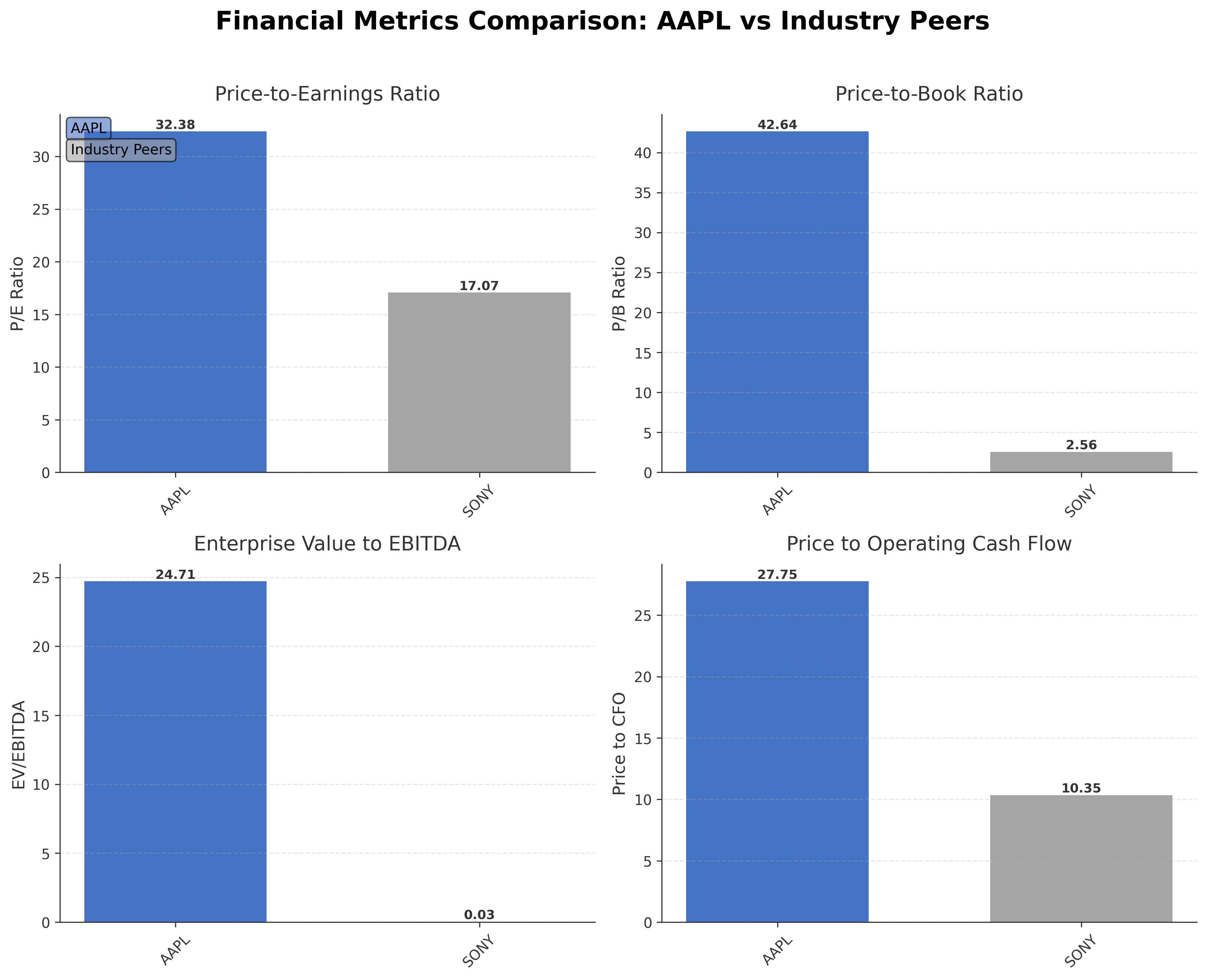
In peer comparison within the consumer electronics sector in the United States, Appleâs valuation metrics such as P/E and P/B ratios are significantly higher than peers like Sony Group Corporation, which has a P/E of 17.07 and P/B of 2.56. Appleâs enterprise value to EBITDA ratio also exceeds that of its peers, indicating a premium valuation that reflects its market dominance and growth prospects. This premium positioning highlights Appleâs leadership but also suggests heightened expectations relative to industry counterparts.
Apple navigates a dynamic technology landscape marked by innovation, competitive challenges, and evolving consumer preferences. Recent achievements include strong financial results and strategic product expansions, while ongoing challenges encompass regulatory developments and market volatility. The companyâs ability to sustain growth and manage risks will be pivotal in maintaining its industry leadership. Given the current data and market context, a balanced approach reflecting cautious observation of valuation and operational trends may be appropriate for those assessing the stockâs potential.
Company and Industry Overview
Company Basics
Price Performance
Company Size
Shareholding Pattern
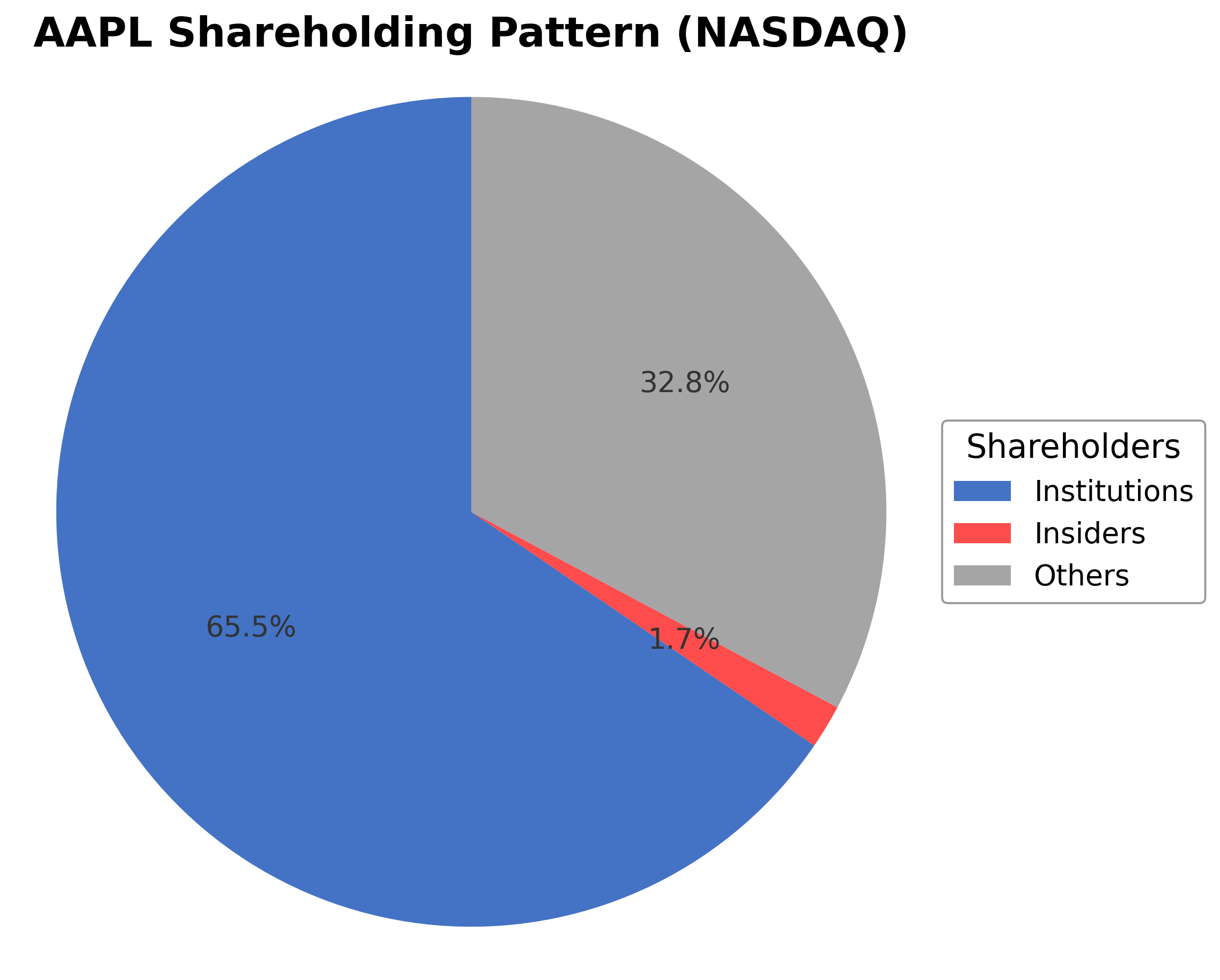
Apple Inc.'s ownership structure features approximately 1.71% held by insiders, 65.48% by institutional investors including mutual funds and asset managers, and the remaining 34.52% held by public and other shareholders. Over the past 12-24 months, institutional ownership has shown fluctuations with some funds increasing stakes, such as Triad Wealth Partners LLC, while others like First Business Financial Services Inc. have reduced holdings. These patterns suggest active institutional engagement reflecting varied market sentiment. The substantial institutional presence supports governance stability and strategic direction, influencing corporate actions and market perceptions within the consumer electronics industry.
Sector and Industry Analysis
Apple Inc. (AAPL) operates primarily within the Technology sector, specifically in the consumer electronics and software industry. This sector is characterized by rapid innovation, significant capital investment, and a large global market. The global consumer electronics market alone is valued in the trillions of USD and continues to grow at a steady pace, driven by increasing consumer demand for smart devices, digital services, and integrated ecosystems. Key players in this space include Apple, Samsung, Google, Microsoft, and Huawei, each competing across hardware, software, and services. Apple's dominant position is underscored by its extensive product portfolio centered around the iPhone, complemented by Mac computers, iPads, wearables like the Apple Watch, and a growing suite of digital services including streaming, subscriptions, and augmented reality applications.
Industry trends reflect a strong shift towards ecosystem integration, where hardware and software are tightly coupled to enhance user experience and lock in customer loyalty. The proliferation of 5G technology, artificial intelligence (AI), augmented reality (AR), and Internet of Things (IoT) devices are reshaping consumer behavior and product development priorities. Consumers increasingly demand seamless connectivity, privacy, and personalized experiences, prompting companies to innovate in chip design (e.g., Apple’s in-house silicon), software platforms, and service offerings. Emerging opportunities lie in augmented reality, health and fitness technology, and subscription-based digital content, where Apple is actively expanding its footprint. Additionally, sustainability and circular economy initiatives are gaining traction, influencing product design and supply chain management.
The regulatory landscape for the technology and consumer electronics industry is complex and evolving, with significant implications for companies like Apple. Key regulatory areas include data privacy (e.g., GDPR in Europe, CCPA in California), antitrust scrutiny, intellectual property rights, and trade policies affecting global supply chains. Compliance with environmental standards and labor laws in manufacturing hubs is also critical. Governments worldwide are increasingly focused on regulating app marketplaces, digital payments, and content moderation, which impacts Apple’s services ecosystem. Regulatory pressures may affect pricing strategies, market access, and operational costs, requiring continuous adaptation and proactive engagement with policymakers.
Competitive dynamics in this sector are intense, with high barriers to entry stemming from the need for advanced technological expertise, substantial R&D investment, and established brand ecosystems. Apple’s competitive positioning benefits from its vertically integrated model, proprietary software and hardware, and a loyal customer base. The company’s supply chain partnerships with firms like Foxconn and TSMC enable scale and innovation efficiency. Market structure is oligopolistic with a few dominant players controlling significant market share, but competition remains fierce on innovation, pricing, and user experience. New entrants face challenges in matching the scale, brand equity, and ecosystem lock-in that incumbents like Apple have cultivated, though niche innovations and regional players continue to emerge.
Note: Analysis synthesized from industry research, market reports, and regulatory filings. Information is subject to change based on market conditions.
Illustrative Scenario Analysis
DCF Assumptions:
Method: Two-Stage EPS-Priority Model
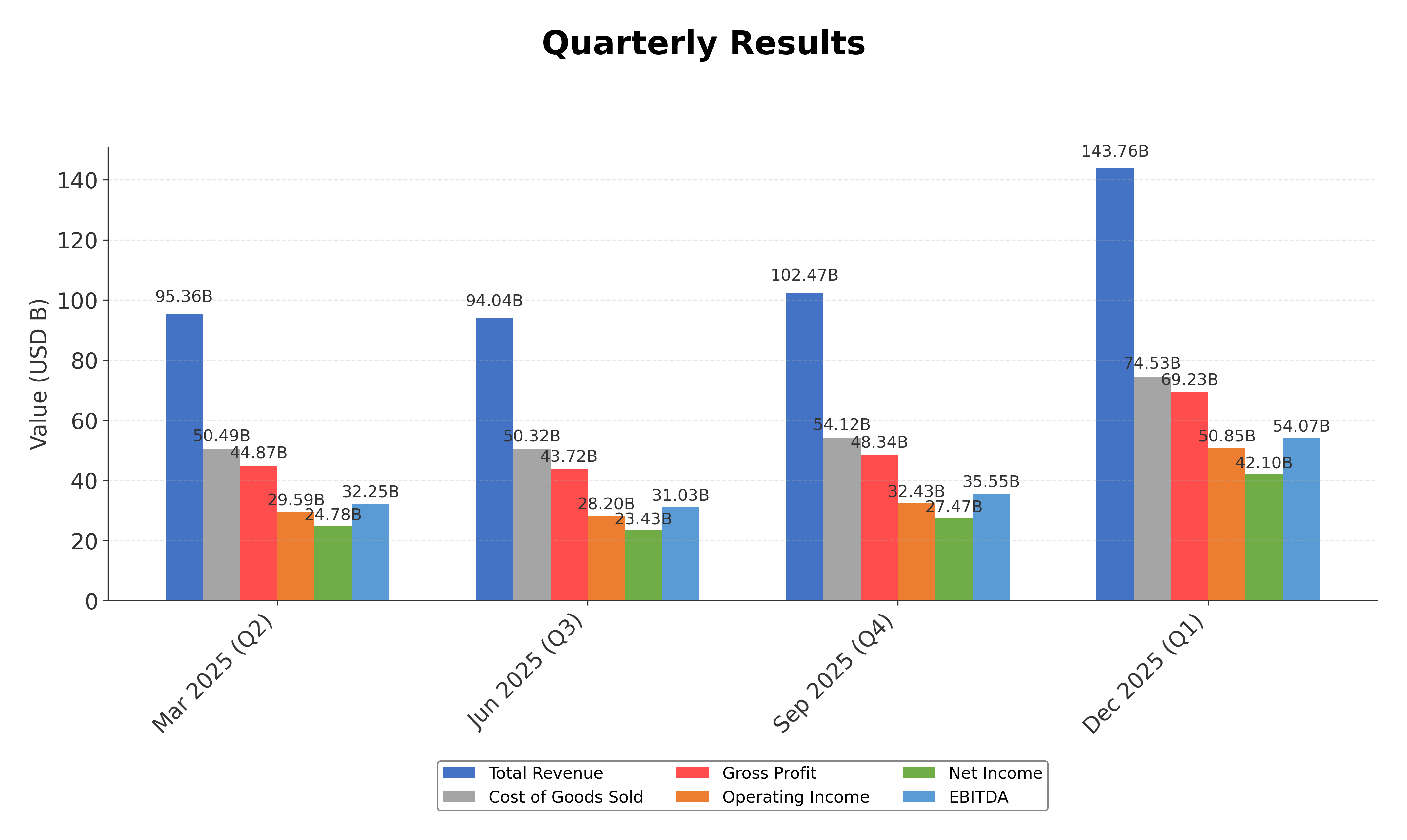
Financials
Peer Analysis
| Company Name | Market Cap | P/E Ratio | P/B Ratio | EV/EBITDA | Price to CFO |
|---|---|---|---|---|---|
| Apple Inc. | $3.76T | 32.38 | 42.64 | 24.71 | 27.75 |
| Sony Group Corporation - Sponsored American Depositary Receipt | $138.29B | 17.07 | 2.56 | 0.03 | 10.35 |
Comparison Analysis: Apple Inc. exhibits significantly higher valuation multiples compared to its peer Sony Group Corporation, with a P/E ratio nearly double and a P/B ratio exceeding 40, reflecting a premium market position. Apple's EV/EBITDA and Price to CFO ratios also surpass those of Sony, indicating higher expectations for profitability and cash flow generation. While Apple’s market capitalization dwarfs that of Sony, these elevated metrics underscore its dominant industry status but also highlight potential valuation risks relative to regional competitors.
Financial Metrics Comparison with Peers
Financial Statements
Comprehensive financial data including income, balance sheet, and cash flow metrics
Income Statement
| fiscal_date | 2025-09-30 | 2024-09-30 | 2023-09-30 | 2022-09-30 | 2021-09-30 |
|---|---|---|---|---|---|
| Sales | 416.16B | 391.04B | 383.29B | 394.33B | 365.82B |
| Cost Of Goods | 220.96B | 210.35B | 214.14B | 223.55B | 212.98B |
| Gross Profit | 195.20B | 180.68B | 169.15B | 170.78B | 152.84B |
| Operating Expense Research And Development | 34.55B | 31.37B | 29.91B | 26.25B | 21.91B |
| Operating Expense Selling General And Administrative | 27.60B | 26.10B | 24.93B | 25.09B | 21.97B |
| Operating Income | 133.05B | 123.22B | 114.30B | 119.44B | 108.95B |
| Other Income Expense | -321.00M | 269.00M | -565.00M | -334.00M | 60.00M |
| Pretax Income | 132.73B | 123.48B | 113.74B | 119.10B | 109.21B |
| Income Tax | 20.72B | 29.75B | 16.74B | 19.30B | 14.53B |
| Net Income | 112.01B | 93.74B | 97.00B | 99.80B | 94.68B |
| Eps Basic | 7.49 | 6.11 | 6.16 | 6.15 | 5.67 |
| Eps Diluted | 7.46 | 6.08 | 6.13 | 6.11 | 5.61 |
| Basic Shares Outstanding | 14.95B | 15.34B | 15.74B | 16.22B | 16.70B |
| Diluted Shares Outstanding | 14.95B | 15.34B | 15.74B | 16.22B | 16.70B |
| Ebit | 133.05B | 123.22B | 114.30B | 119.44B | 111.85B |
| Ebitda | 144.75B | 134.66B | 125.82B | 130.54B | 123.14B |
| Net Income Continuous Operations | 112.01B | 93.74B | 97.00B | 99.80B | 94.68B |
| Non Operating Interest Income | N/A | N/A | 3.75B | 2.83B | 2.84B |
| Non Operating Interest Expense | N/A | N/A | 3.93B | 2.93B | 2.65B |
Source: Financial statements and regulatory filings
Balance Sheet
| fiscal_date | 2025-12-31 | 2025-09-30 | 2025-06-30 | 2025-03-31 | 2024-12-31 |
|---|---|---|---|---|---|
| Cash And Cash Equivalents | 45.32B | 35.93B | 36.27B | 28.16B | 30.30B |
| Accounts Receivable | 39.92B | 39.78B | 27.56B | 26.14B | 29.64B |
| Total Assets | 379.30B | 359.24B | 331.50B | 331.23B | 344.08B |
| Total Liabilities | 291.11B | 285.51B | 265.67B | 264.44B | 277.33B |
| Long Term Debt | 76.69B | 78.33B | 82.43B | 78.57B | 83.96B |
| Shareholders Equity | 88.19B | 73.73B | 65.83B | 66.80B | 66.76B |
Source: Financial statements and regulatory filings
Cash Flow Statement
| fiscal_date | 2025-09-30 | 2024-09-30 | 2023-09-30 | 2022-09-30 | 2021-09-30 |
|---|---|---|---|---|---|
| Operating Activities Net Income | 112.01B | 93.74B | 97.00B | 99.80B | 94.68B |
| Operating Activities Depreciation | 11.70B | 11.45B | 11.52B | 11.10B | 11.28B |
| Operating Activities Stock Based Compensation | 12.86B | 11.69B | 10.83B | 9.04B | 7.91B |
| Operating Activities Other Non Cash Items | -89.00M | -2.27B | -2.23B | 1.01B | -4.92B |
| Operating Activities Accounts Receivable | -7.03B | -5.14B | -417.00M | -9.34B | -14.03B |
| Operating Activities Accounts Payable | 902.00M | 6.02B | -1.89B | 9.45B | 12.33B |
| Operating Activities Other Assets Liabilities | -18.87B | 2.77B | -4.27B | 1.57B | -1.53B |
| Operating Activities Operating Cash Flow | 111.48B | 118.25B | 110.54B | 123.52B | 100.94B |
| Investing Activities Capital Expenditures | -12.71B | -9.45B | -10.96B | -10.71B | -11.09B |
| Investing Activities Purchase Of Investments | -24.41B | -48.66B | -29.51B | -76.92B | -109.56B |
| Investing Activities Sale Of Investments | 53.80B | 62.35B | 45.51B | 67.36B | 106.48B |
| Investing Activities Other Investing Activity | -1.48B | -1.31B | -1.34B | -2.09B | -385.00M |
| Investing Activities Investing Cash Flow | 15.20B | 2.94B | 3.71B | -22.66B | -14.58B |
| Financing Activities Long Term Debt Issuance | 4.48B | 0.00 | 5.23B | 5.46B | 20.39B |
| Financing Activities Long Term Debt Payments | -10.93B | -9.96B | -11.15B | -9.54B | -8.75B |
| Financing Activities Short Term Debt Issuance | -2.03B | 3.96B | -3.98B | 3.96B | 1.02B |
| Financing Activities Common Stock Repurchase | -90.71B | -94.95B | -77.55B | -89.40B | -85.97B |
| Financing Activities Common Dividends | -15.42B | -15.23B | -15.03B | -14.84B | -14.47B |
| Financing Activities Other Financing Charges | -6.07B | -5.80B | -6.01B | -6.38B | -5.58B |
| Financing Activities Financing Cash Flow | -120.69B | -121.98B | -108.49B | -110.75B | -92.25B |
| End Cash Position | 35.93B | 29.94B | 30.74B | 24.98B | 35.93B |
| Income Tax Paid | 43.37B | 26.10B | 18.68B | 19.57B | 25.39B |
| Free Cash Flow | 98.77B | 108.81B | 99.58B | 111.44B | 92.95B |
| Interest Paid | N/A | N/A | 3.80B | 2.87B | 2.69B |
| Operating Activities Deferred Taxes | N/A | N/A | N/A | 895.00M | -4.77B |
| Investing Activities Net Acquisitions | N/A | N/A | N/A | -306.00M | -33.00M |
| Financing Activities Common Stock Issuance | N/A | N/A | N/A | N/A | 1.10B |
Source: Financial statements and regulatory filings
Technical Analysis
Key Insights
- Apple's current trend shows a generally upward momentum with the stock price trading above the 200-day moving average at $240.06 but below the 50-day moving average of $267.48, indicating potential short-term consolidation.
- Key support levels are identified near $240.00 (200-day MA) and $169.21 (52-week low), while resistance is observed around $288.62 (52-week high) and $267.48 (50-day MA).
- The stock is positioned between its 10-day, 50-day, and 200-day moving averages, suggesting mixed signals across short and long-term trends.
- Momentum indicators show a Relative Strength Index (RSI) near neutral levels, MACD lines converging without a clear crossover, and Stochastic oscillators indicating moderate momentum without extreme overbought or oversold conditions.
- Multi-timeframe analysis reveals steady price action on the weekly and monthly charts, with daily charts showing minor volatility and sideways movement.
- Current technical setup suggests a market scenario of cautious optimism with potential for continuation of the prevailing trend if resistance levels are breached, or consolidation if support levels are tested.
Trending News
1. Headline: Apple Quietly Drops ESG Links From Top Executives’ Pay Packages
Summary: Apple Inc. has removed environmental, social, and governance (ESG) modifiers from the 2025 compensation packages for CEO Tim Cook and other executives, signaling a shift in corporate incentive structures. This change reflects evolving priorities in executive remuneration and may influence perceptions of Apple's commitment to ESG goals.
Sentiment: Negative
2. Headline: Apple Offers Haven From AI-Driven Swings as Nasdaq Ties Weaken (AAPL) - Bloomberg
Summary: Apple Inc. has demonstrated resilience amid recent AI-driven market volatility, decoupling from broader Nasdaq tech sector swings. This stability positions Apple as a comparatively steady option within a fluctuating technology market environment.
Sentiment: Positive
3. Headline: First Business Financial Services Inc. Lowers Stock Holdings in Apple Inc. $AAPL
Summary: First Business Financial Services Inc. reduced its holdings in Apple Inc. by 5.3% during the third quarter, reflecting a strategic portfolio adjustment. The fund's reduced position may indicate a cautious stance or reallocation of assets within its investment strategy.
Sentiment: Positive
4. Headline: Apple Inc. $AAPL Shares Acquired by Triad Wealth Partners LLC
Summary: Triad Wealth Partners LLC increased its stake in Apple Inc. by 82.6% in the third quarter, signaling confidence in the company's prospects. This significant acquisition reflects positive sentiment from this institutional investor.
Sentiment: Positive
5. Headline: Bailard Inc. Reduces Position in Apple Inc. $AAPL
Summary: Bailard Inc. decreased its holdings in Apple Inc. by 3.8% during the third quarter, suggesting a modest portfolio rebalancing. This reduction may reflect tactical adjustments rather than a fundamental shift in outlook.
Sentiment: Positive
Recent Updates
News Summary
Recent news highlights Apple's strategic focus on artificial intelligence and content integration, including collaborations with Google to bring AI music creation to mainstream consumers and the development of AI-powered wearable devices. The company is also enhancing its digital content offerings with integrated video podcasts, positioning itself competitively against platforms like Spotify and YouTube. Institutional activity includes significant stake adjustments by major funds, reflecting active portfolio management. These developments collectively underscore Apple's commitment to innovation and ecosystem expansion amid evolving market dynamics.
News Sentiment
Sentiment across recent updates is mixed to moderately positive, with innovation and strategic content initiatives driving optimism, while some concerns arise from leadership compensation changes and competitive pressures in AI hardware. Institutional trading activity suggests cautious confidence with both accumulation and distribution observed among key shareholders.
Analytical Overview
Analysis Summary
Valuation Metrics: Apple's trailing P/E of 32.38 and forward P/E of 27.54 are in line with the consumer electronics industry average of 32.38, indicating valuation consistency with sector peers. The PEG ratio of 1.77 suggests moderate growth expectations relative to price.
Growth Trajectory: Revenue growth of 15.7% year-over-year and quarterly earnings growth of 15.9% demonstrate a robust growth trajectory supported by strong cash flow generation, with operating cash flow exceeding $135 billion.
Financial Health: The company maintains a debt-to-equity ratio near 0.95, reflecting balanced leverage, alongside a current ratio just below 1.0, indicating tight but manageable liquidity. Free cash flow of over $106 billion supports financial flexibility.
Sector Specific Factors: Apple faces sector-specific opportunities in AI integration and digital services expansion, while challenges include regulatory scrutiny and competitive pressures in hardware innovation. Market positioning benefits from brand strength and ecosystem integration.
Investment Conclusion
Supporting Factors: Strong revenue and earnings growth underpinning financial performance.
Risk Factors: High valuation multiples relative to some peers may constrain upside.
SWOT Analysis
Strengths
- Market leadership with a strong global brand and ecosystem.
- Robust revenue growth and high profit margins.
- Significant cash flow generation enabling strategic investments.
- Diverse product portfolio spanning hardware and services.
Weaknesses
- High price-to-book ratio indicating premium valuation.
- Current ratio below 1.0 suggesting tight short-term liquidity.
- Dependence on flagship products like the iPhone for majority of revenue.
- Executive compensation changes may affect stakeholder perceptions.
Opportunities
- Expansion into AI-powered devices and services.
- Growth in digital content and subscription platforms.
- Strategic partnerships enhancing innovation capabilities.
- Increasing demand for integrated technology ecosystems.
Threats
- Regulatory scrutiny and evolving ESG expectations.
- Intense competition in consumer electronics and software.
- Market volatility influenced by macroeconomic factors.
- Potential shifts in institutional investor sentiment.
Company Description
Apple Inc. is a leading technology company renowned for designing, manufacturing, and marketing innovative hardware and software products for consumers and businesses worldwide. Its flagship product, the iPhone, accounts for the majority of sales, serving as the central hub of an expansive ecosystem that includes Mac computers, iPad tablets, Apple Watch wearables, and accessories like AirPods. Apple Inc. also offers a suite of services such as the App Store, Apple Music, iCloud, Apple TV+, and Apple Fitness+, providing digital content, cloud storage, and subscription-based platforms. Operating in the consumer electronics industry within the technology sector, the company employs approximately 166,000 people and maintains a broad global presence through online stores, retail outlets, and partnerships with carriers and resellers. With a substantial market capitalization reflecting its scale, Apple Inc. plays a pivotal role in shaping consumer technology trends, emphasizing seamless integration across devices and services to enhance user experience and productivity.