


Apple Inc (AAPL)
Stock Analysis Report
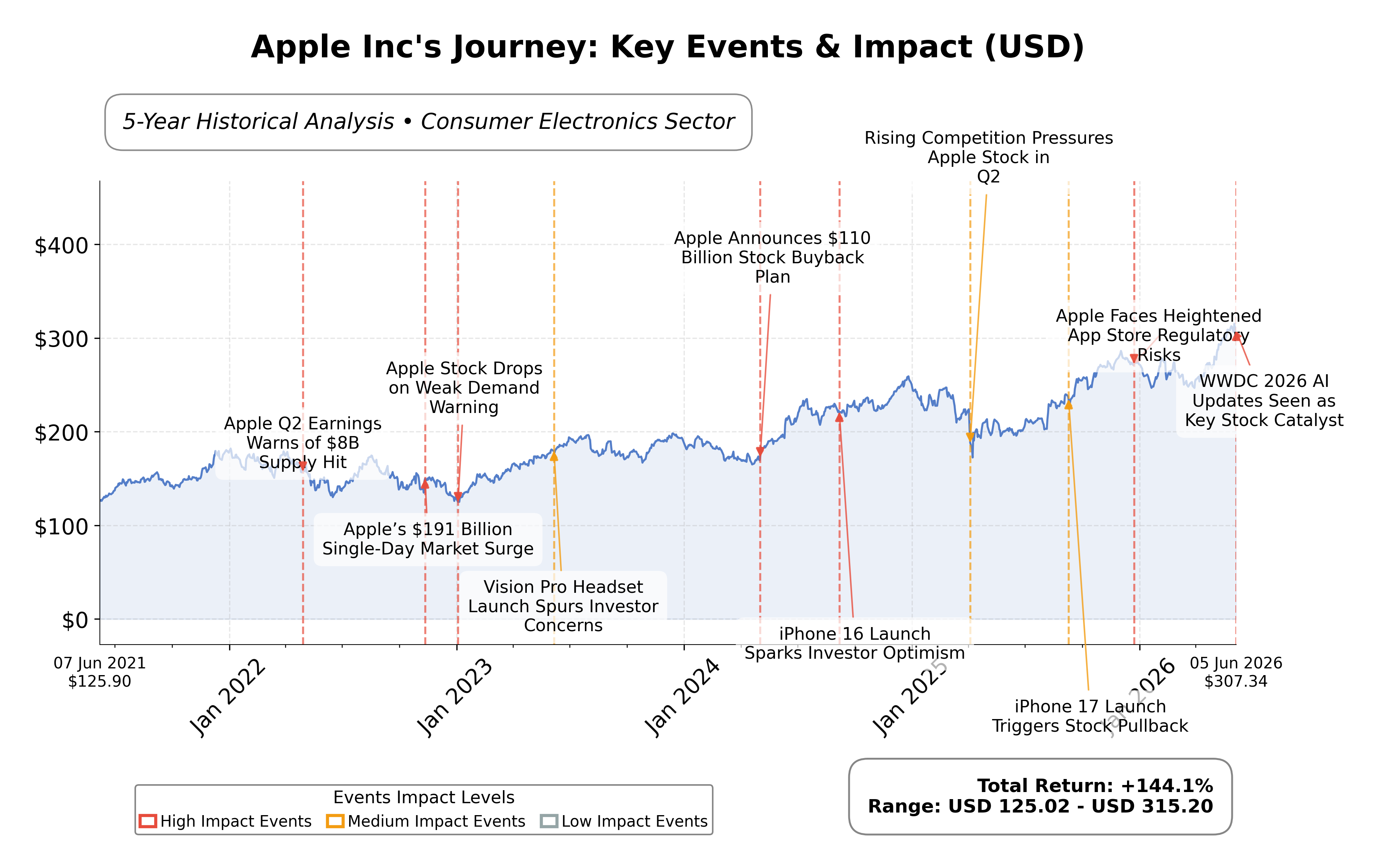
Stock Journey
Key Positives and Key Risks
Pros
- Revenue growth of 16-17% year-over-year demonstrates strong demand and market expansion.
- Operating cash flow of $140.2 billion and free cash flow of $101.1 billion indicate robust liquidity and capital flexibility.
- Market capitalization of $4.58 trillion reflects dominant industry position and investor confidence.
Cons
- High trailing P/E ratio of 37.58 and price-to-book ratio of 42.81 suggest premium valuation levels.
- Debt-to-equity ratio of 79.5% indicates moderate leverage that may constrain financial flexibility.
- Recent institutional selling by Payden & Rygel signals some investor caution amid market uncertainties.
Disclosure: This information is for general awareness and does not constitute investment advice
Report Summary
Apple Inc. is a leading global technology company listed on NASDAQ under the symbol AAPL, operating primarily in the Technology sector with a focus on Consumer Electronics. The company designs, manufactures, and markets a broad portfolio of products including the iPhone, Mac computers, iPads, wearables like Apple Watch and AirPods, and services such as the App Store and Apple Music. Apple’s integrated ecosystem and strong brand position it as a dominant player in mobile communication, personal computing, and digital services worldwide.
Financially, Apple reported trailing twelve months revenue of approximately $451.4 billion with a gross margin of 49.3%, operating margin of 32.3%, and a net profit margin of 27.2%, reflecting strong profitability and operational efficiency. The company’s return on equity (ROE) stands at 141.47%, and return on assets (ROA) at 26.23%, indicating excellent capital utilization and asset productivity. Operating cash flow was robust at $140.2 billion with free cash flow of $101.1 billion, underscoring strong cash generation capabilities.
Apple’s valuation metrics show a trailing P/E ratio of 37.58, forward P/E of 32.35, and an EV/EBITDA multiple of 28.64, positioning the stock at a premium relative to industry averages. The market capitalization is approximately $4.58 trillion, with the stock trading near $307.39, close to its 52-week high of $315, within a range of $195.07 to $315. The price-to-book ratio is elevated at 42.81, reflecting significant market expectations for growth and innovation.
Key strengths include Apple’s massive cash reserves of $68.5 billion, moderate debt levels with a debt-to-equity ratio of 79.5%, and a strong installed base exceeding 2.5 billion active devices. Risks involve competitive pressures in technology innovation, regulatory scrutiny, and supply chain constraints. Recent strategic actions include new product launches such as the iPhone 17e, M4-powered iPad Air, and MacBook Neo, alongside a leadership transition with Tim Cook moving to Executive Chairman and John Ternus becoming CEO.
Technically, Apple’s stock is trading above its 50-day and 200-day moving averages, with momentum indicators suggesting positive price action across multiple timeframes. Market sentiment is buoyed by anticipation of AI-driven product enhancements following the upcoming WWDC event. Overall, the data suggests a market environment that may favor continued interest and accumulation while warranting close monitoring of evolving fundamentals and external factors.
Company and Industry Overview
Company Basics
Price Performance
Company Size
Shareholding Pattern
Sector and Industry Analysis
The global apple market, a vital segment within the agricultural sector, is characterized by a diverse product range and a complex value chain from cultivation to retail. The market has experienced steady growth driven by rising health awareness and demand for organic produce, with projections indicating continued expansion through 2034 across major regions including North America, Europe, and Asia-Pacific. Key players range from multinational corporations to local producers, competing in a landscape shaped by technological advancements and evolving consumer preferences.
Emerging trends in the apple industry include increased consumer demand for organic and locally sourced products, innovations in packaging and storage technologies, and adoption of smart farming techniques to enhance yield and sustainability. Competitive dynamics are influenced by intensified pressures from international players expanding operations and the need for local producers to innovate and diversify. Barriers such as climatic challenges, stringent food safety regulations, and fluctuating trade tariffs affect market entry and operational efficiency, requiring adaptive strategies and investment in resilient agricultural practices.
The regulatory environment is increasingly stringent, with food safety and quality standards tightening globally to ensure consumer protection and product integrity. Trade policies and tariff shifts, influenced by geopolitical developments, impact apple distribution and pricing, particularly in emerging markets. Additionally, sustainability-related regulations and carbon pricing frameworks are shaping industry practices, encouraging producers to adopt environmentally friendly methods and align with evolving policy frameworks that influence long-term market dynamics.
Note: Analysis synthesized from industry research, market reports, and regulatory filings. Information is subject to change based on market conditions.
Financial Ratios Dashboard
Illustrative Scenario Analysis
DCF Assumptions:
Method: Two-Stage EPS-Priority Model
Financials
Peer Analysis
| Company Name | Market Cap | P/E Ratio | P/B Ratio | EV/EBITDA | Price to CFO |
|---|---|---|---|---|---|
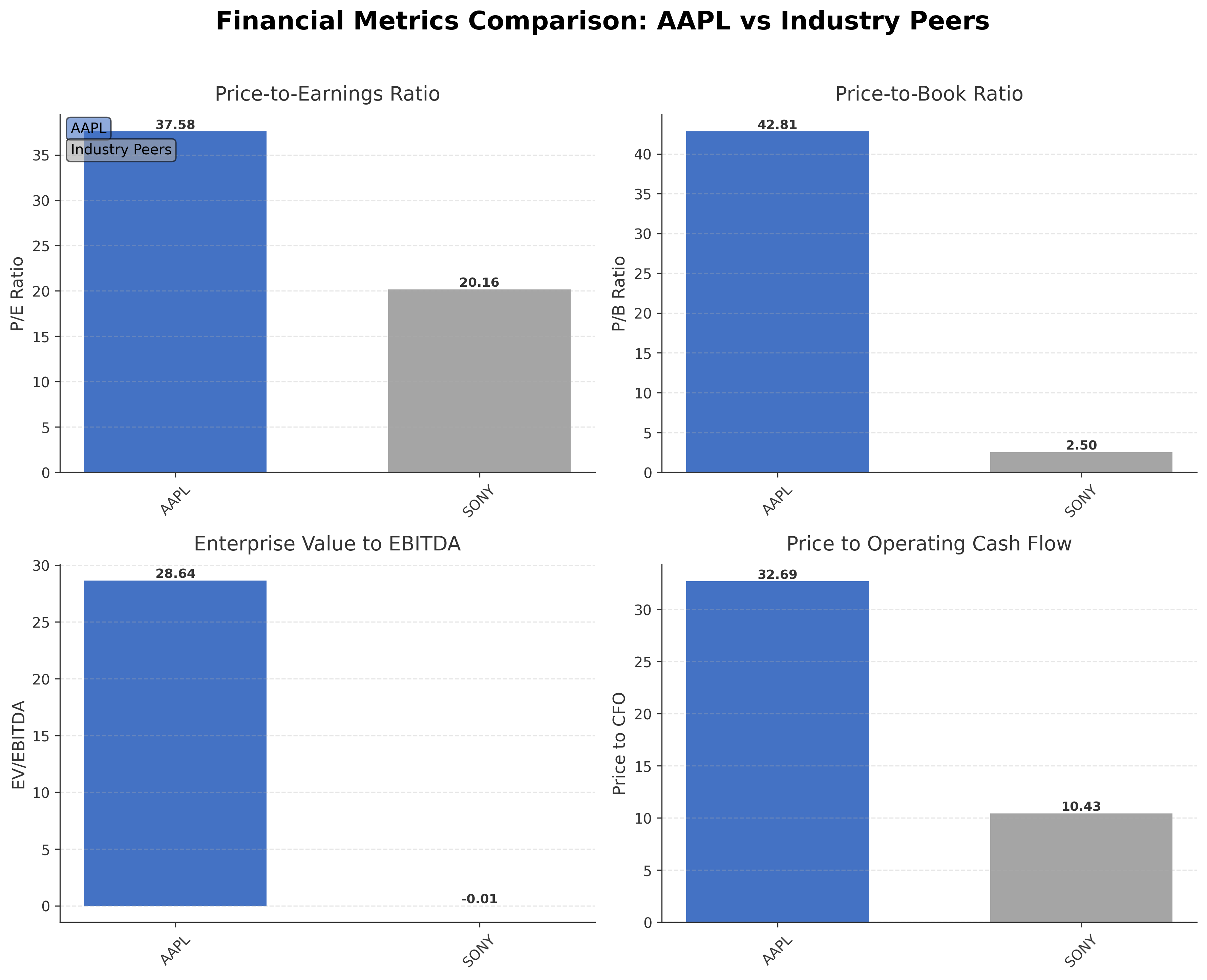
| Apple Inc | $4.58T | 37.58 | 42.81 | 28.64 | 32.69 |
| Sony Group Corporation | $127.44B | 20.16 | 2.50 | -0.01 | 10.43 |
Comparison Analysis: Apple Inc. significantly outpaces its peer Sony Group Corporation in market capitalization, with a valuation exceeding $4.5 trillion compared to Sony's $127 billion. Apple’s P/E ratio of 37.58 is substantially higher than Sony’s 20.16, reflecting greater market expectations for growth and profitability. The price-to-book ratio for Apple at 42.81 is markedly elevated relative to Sony’s 2.50, indicating a premium valuation. Apple’s EV/EBITDA multiple of 28.64 contrasts with Sony’s near zero, suggesting stronger earnings before interest, taxes, depreciation, and amortization. Return on equity for Apple is also higher at 1.41% versus Sony’s 0.12%, highlighting superior capital efficiency. Overall, Apple demonstrates dominant scale and premium valuation metrics relative to its regional industry peer.
Financial Metrics Comparison with Peers
Financial Statements
Comprehensive financial data including income, balance sheet, and cash flow metrics
Income Statement
| fiscal_date | 2025-09-30 | 2024-09-30 | 2023-09-30 | 2022-09-30 | 2021-09-30 |
|---|---|---|---|---|---|
| Sales | 416.16B | 391.04B | 383.29B | 394.33B | 365.82B |
| Cost Of Goods | 220.96B | 210.35B | 214.14B | 223.55B | 212.98B |
| Gross Profit | 195.20B | 180.68B | 169.15B | 170.78B | 152.84B |
| Operating Expense Research And Development | 34.55B | 31.37B | 29.91B | 26.25B | 21.91B |
| Operating Expense Selling General And Administrative | 27.60B | 26.10B | 24.93B | 25.09B | 21.97B |
| Operating Income | 133.05B | 123.22B | 114.30B | 119.44B | 108.95B |
| Other Income Expense | -321.00M | 269.00M | -565.00M | -334.00M | 60.00M |
| Pretax Income | 132.73B | 123.48B | 113.74B | 119.10B | 109.21B |
| Income Tax | 20.72B | 29.75B | 16.74B | 19.30B | 14.53B |
| Net Income | 112.01B | 93.74B | 97.00B | 99.80B | 94.68B |
| Eps Basic | 7.49 | 6.11 | 6.16 | 6.15 | 5.67 |
| Eps Diluted | 7.46 | 6.08 | 6.13 | 6.11 | 5.61 |
| Basic Shares Outstanding | 14.95B | 15.34B | 15.74B | 16.22B | 16.70B |
| Diluted Shares Outstanding | 14.95B | 15.34B | 15.74B | 16.22B | 16.70B |
| Ebit | 133.05B | 123.22B | 114.30B | 119.44B | 111.85B |
| Ebitda | 144.75B | 134.66B | 125.82B | 130.54B | 123.14B |
| Net Income Continuous Operations | 112.01B | 93.74B | 97.00B | 99.80B | 94.68B |
| Non Operating Interest Income | N/A | N/A | 3.75B | 2.83B | 2.84B |
| Non Operating Interest Expense | N/A | N/A | 3.93B | 2.93B | 2.65B |
Data provided by Twelve Data
Balance Sheet
| fiscal_date | 2025-09-30 | 2024-09-30 | 2023-09-30 | 2022-09-30 | 2021-09-30 |
|---|---|---|---|---|---|
| Cash And Cash Equivalents | 35.93B | 29.94B | 29.96B | 23.65B | 34.94B |
| Accounts Receivable | 39.78B | 33.41B | 29.51B | 28.18B | 26.28B |
| Total Assets | 359.24B | 364.98B | 352.58B | 352.75B | 351.00B |
| Total Liabilities | 285.51B | 308.03B | 290.44B | 302.08B | 287.91B |
| Long Term Debt | 78.33B | 85.75B | 95.28B | 109.71B | 119.38B |
| Shareholders Equity | 73.73B | 56.95B | 62.15B | 50.67B | 63.09B |
Data provided by Twelve Data
Cash Flow Statement
| fiscal_date | 2025-09-30 | 2024-09-30 | 2023-09-30 | 2022-09-30 | 2021-09-30 |
|---|---|---|---|---|---|
| Operating Activities Net Income | 112.01B | 93.74B | 97.00B | 99.80B | 94.68B |
| Operating Activities Depreciation | 11.70B | 11.45B | 11.52B | 11.10B | 11.28B |
| Operating Activities Stock Based Compensation | 12.86B | 11.69B | 10.83B | 9.04B | 7.91B |
| Operating Activities Other Non Cash Items | -89.00M | -2.27B | -2.23B | 1.01B | -4.92B |
| Operating Activities Accounts Receivable | -7.03B | -5.14B | -417.00M | -9.34B | -14.03B |
| Operating Activities Accounts Payable | 902.00M | 6.02B | -1.89B | 9.45B | 12.33B |
| Operating Activities Other Assets Liabilities | -18.87B | 2.77B | -4.27B | 1.57B | -1.53B |
| Operating Activities Operating Cash Flow | 111.48B | 118.25B | 110.54B | 123.52B | 100.94B |
| Investing Activities Capital Expenditures | -12.71B | -9.45B | -10.96B | -10.71B | -11.09B |
| Investing Activities Purchase Of Investments | -24.41B | -48.66B | -29.51B | -76.92B | -109.56B |
| Investing Activities Sale Of Investments | 53.80B | 62.35B | 45.51B | 67.36B | 106.48B |
| Investing Activities Other Investing Activity | -1.48B | -1.31B | -1.34B | -2.09B | -385.00M |
| Investing Activities Investing Cash Flow | 15.20B | 2.94B | 3.71B | -22.66B | -14.58B |
| Financing Activities Long Term Debt Issuance | 4.48B | 0.00 | 5.23B | 5.46B | 20.39B |
| Financing Activities Long Term Debt Payments | -10.93B | -9.96B | -11.15B | -9.54B | -8.75B |
| Financing Activities Short Term Debt Issuance | -2.03B | 3.96B | -3.98B | 3.96B | 1.02B |
| Financing Activities Common Stock Repurchase | -90.71B | -94.95B | -77.55B | -89.40B | -85.97B |
| Financing Activities Common Dividends | -15.42B | -15.23B | -15.03B | -14.84B | -14.47B |
| Financing Activities Other Financing Charges | -6.07B | -5.80B | -6.01B | -6.38B | -5.58B |
| Financing Activities Financing Cash Flow | -120.69B | -121.98B | -108.49B | -110.75B | -92.25B |
| End Cash Position | 35.93B | 29.94B | 30.74B | 24.98B | 35.93B |
| Income Tax Paid | 43.37B | 26.10B | 18.68B | 19.57B | 25.39B |
| Free Cash Flow | 98.77B | 108.81B | 99.58B | 111.44B | 92.95B |
| Interest Paid | N/A | N/A | 3.80B | 2.87B | 2.69B |
| Operating Activities Deferred Taxes | N/A | N/A | N/A | 895.00M | -4.77B |
| Investing Activities Net Acquisitions | N/A | N/A | N/A | -306.00M | -33.00M |
| Financing Activities Common Stock Issuance | N/A | N/A | N/A | N/A | 1.10B |
Data provided by Twelve Data
Technical Analysis
Key Insights
- Apple’s stock is currently in an uptrend, trading above key moving averages with steady price appreciation observed over recent sessions.
- Key support levels are identified near $270 and $260, while resistance is observed around the 52-week high near $315.
- The stock price is above its 10-day, 50-day ($272.88), and 200-day ($262.40) moving averages, indicating sustained bullish momentum.
- Momentum indicators show RSI in the mid-60s, MACD trending positively above the signal line, and Stochastic oscillators confirming upward momentum.
- Analysis across daily, weekly, and monthly timeframes consistently reflects strength with no immediate signs of reversal.
- Potential market scenarios include continuation of the upward trend if support levels hold, while a breach below $260 could signal consolidation or correction.
Trending News
1. Headline: Payden & Rygel Sells 2,000 Shares of Apple Inc. $AAPL
Summary: Payden & Rygel decreased its stake in shares of Apple Inc. (NASDAQ:AAPL - Free Report) by 10.6% during the fourth quarter, according to the company in its most recent Form 13F filing with the Securities & Exchange Commission. The firm owned 16,800 shares of the iPhone maker's stock after sellin
Sentiment: negative
Summary: Apple Inc. stock could see a significant surge following the Worldwide Developers Conference (WWDC), scheduled from June 8 to June 12, said Morgan Stanley. The bank suggested that the “AI winner” narrative has been a key turning point for numerous...
Sentiment: positive
3. Headline: Apple stock is coming hot into next week's WWDC. How the company can meet the moment
Summary: Should this new Siri not only wow ... Apple will benefit by monetizing it on its devices and services. Richer AI features could also catalyze a quicker pace of upgrades, or a change in the sales mix toward higher-end devices with more computing power, which is becoming increasingly valuable in the era of artificial intelligence. (Jim Cramer's Charitable Trust is long AAPL, GOOGL. See here for a full list of the stocks....
Sentiment: positive
4. Headline: Apple closing stores: list of shuttered locations for 2026 - Fast Company
Summary: Three Apple Stores will close this month as the company cites worsening conditions at their shopping centers.
Sentiment: negative
5. Headline: Chinese satellite company releases images of Nvidia, Apple HQs | South China Morning Post
Summary: Photos offering bird’s-eye view of the campuses are ‘routine satellite news’ according to the firm, which has been sanctioned by the US.
Sentiment: neutral
Powered by Brave
Recent Updates
News Summary
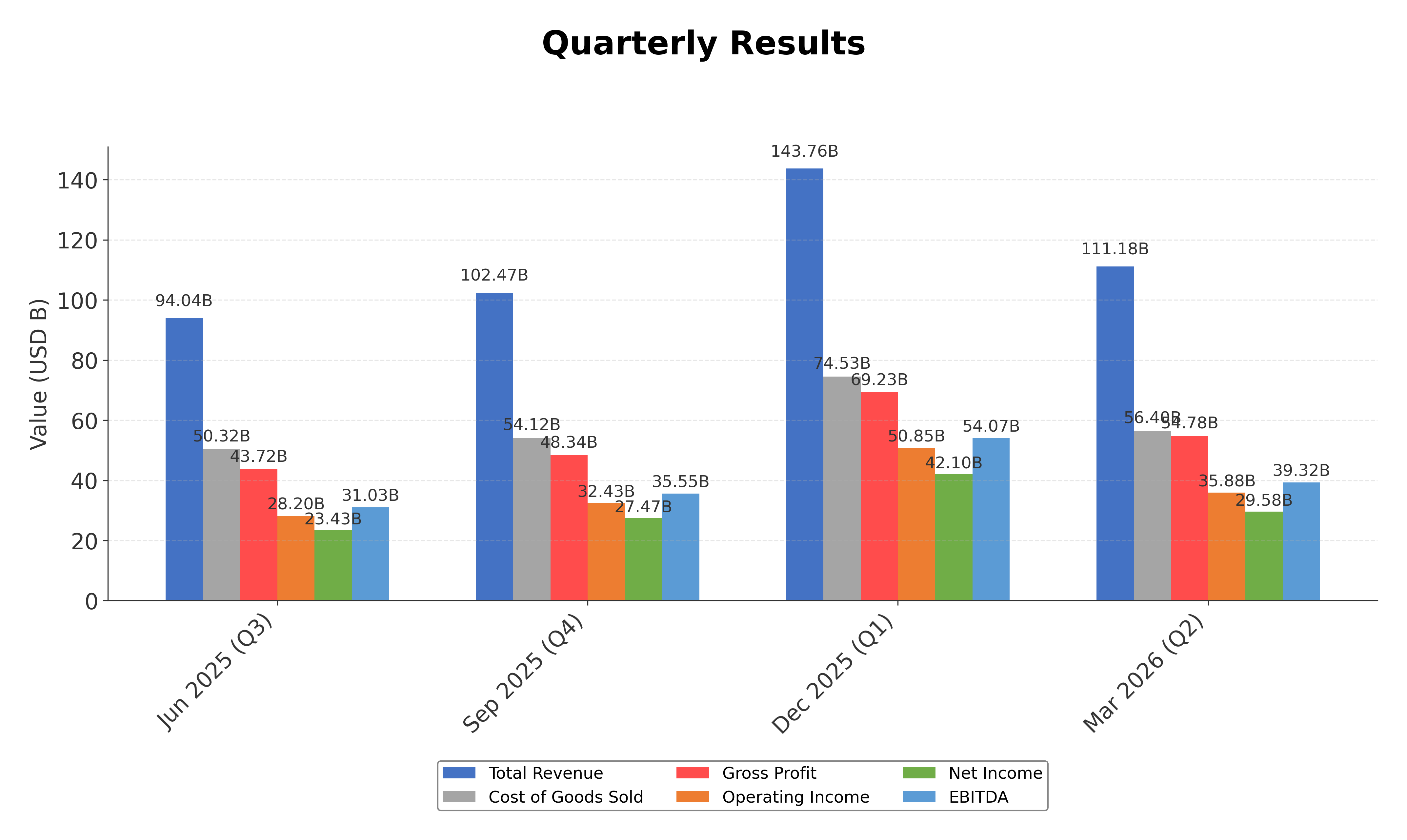
As of April 30, 2026. Apple reported record-breaking financial results for its fiscal second quarter ended March 28, 2026, with revenue reaching $111.2 billion, a 17% increase year-over-year, driven by strong iPhone 17 lineup sales and all-time high Services revenue. Diluted EPS rose 22% to $2.01, supported by robust operating cash flow exceeding $28 billion. The company announced a 4% increase in its quarterly dividend to $0.27 per share and authorized an additional $100 billion share repurchase program. Leadership transition plans were disclosed, with Tim Cook moving to Executive Chairman and John Ternus assuming the CEO role. The outlook for the June quarter anticipates 14%-17% revenue growth amid supply constraints and rising costs.
News Sentiment
The overall sentiment from recent updates is predominantly positive, reflecting strong financial performance and strategic initiatives. Record revenues and earnings growth underscore Apple's operational strength, while dividend increases and share repurchase authorization signal confidence in capital allocation. Leadership changes have been communicated clearly, maintaining market stability. Some neutral tones arise from cautious guidance on supply chain challenges and cost pressures. The balance of positive financial results and strategic clarity supports a constructive view of the company’s near-term prospects.
Source List
- https://www.cnbc.com/2026/04/30/apple-aapl-q2-2026-earnings-report.html
Analytical Overview
Analysis Summary
Apple’s valuation metrics, including a trailing P/E of 37.58 and forward P/E of 32.35, are elevated compared to industry averages, reflecting strong market expectations for growth and innovation. The company’s revenue growth of 16-17% year-over-year and robust cash flow trends demonstrate a solid growth trajectory supported by high demand for flagship products and expanding services. Financial health is sound, with a manageable debt-to-equity ratio of 79.5% and strong operating cash flow of $140.2 billion, indicating liquidity and capital flexibility. Sector-specific opportunities include advancements in AI integration and expanding digital services, while challenges encompass supply chain constraints and competitive pressures. Market positioning and competitive advantages are underpinned by Apple’s ecosystem, brand loyalty, and continuous innovation.
Overall Business and Market Assessment
Supporting Factors: record revenue and EPS growth, strong cash generation, and strategic leadership transition ensuring continuity
Risk Factors: No data
SWOT Analysis
Strengths
- Market leadership with a diversified product and services ecosystem.
- Strong profitability with high gross and net margins.
- Robust cash flow generation supporting capital returns and investments.
- Extensive global installed base exceeding 2.5 billion active devices.
Weaknesses
- High price-to-book ratio indicating premium valuation.
- Moderate debt levels with a debt-to-equity ratio near 80%.
- Dependence on iPhone sales for a significant portion of revenue.
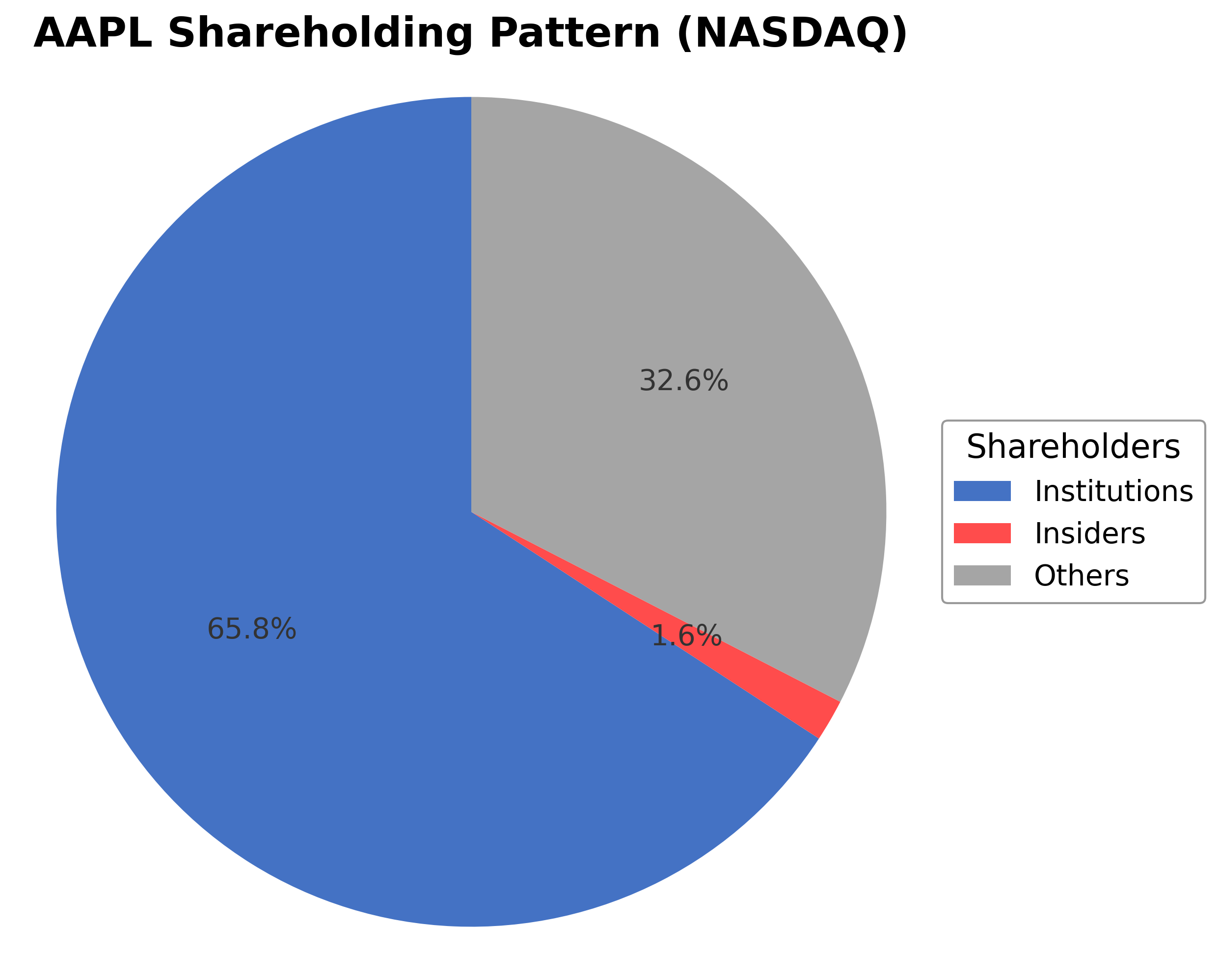
- Limited insider ownership potentially reducing direct executive stake alignment.
Opportunities
- Expansion of AI capabilities and integration in products and services.
- Growth in digital services and subscription revenue streams.
- Increasing adoption of wearables and health monitoring devices.
- Potential market penetration in emerging economies.
Threats
- Supply chain constraints and rising component costs.
- Intense competition in consumer electronics and technology services.
- Regulatory scrutiny and geopolitical tensions affecting operations.
- Retail store closures impacting physical sales channels.
Company Description
Apple Inc. designs, manufactures, and markets a wide range of technology products worldwide. These include the iPhone, a line of smartphones; Mac, a line of personal computers; iPad, a line of multi-purpose tablets; and wearables, home, and accessories such as AirPods, Apple Vision Pro, Apple TV, Apple Watch, Beats products, HomePod, as well as Apple branded and third-party accessories. The company operates service platforms including the App Store, Apple Music, and subscription models that provide curated content, cloud services, and digital offerings. Apple Inc. serves individual consumers, businesses, and government sectors through online stores, retail outlets, and partnerships with cellular carriers and resellers. Its products span the information technology sector, impacting mobile communication, personal computing, entertainment, and health monitoring. Founded in 1976 and headquartered in Cupertino, California, Apple Inc. plays a pivotal role in the global technology market by integrating hardware, software, and services into seamless ecosystems.