


AAPL (AAPL)
Stock Analysis Report
Stock Journey
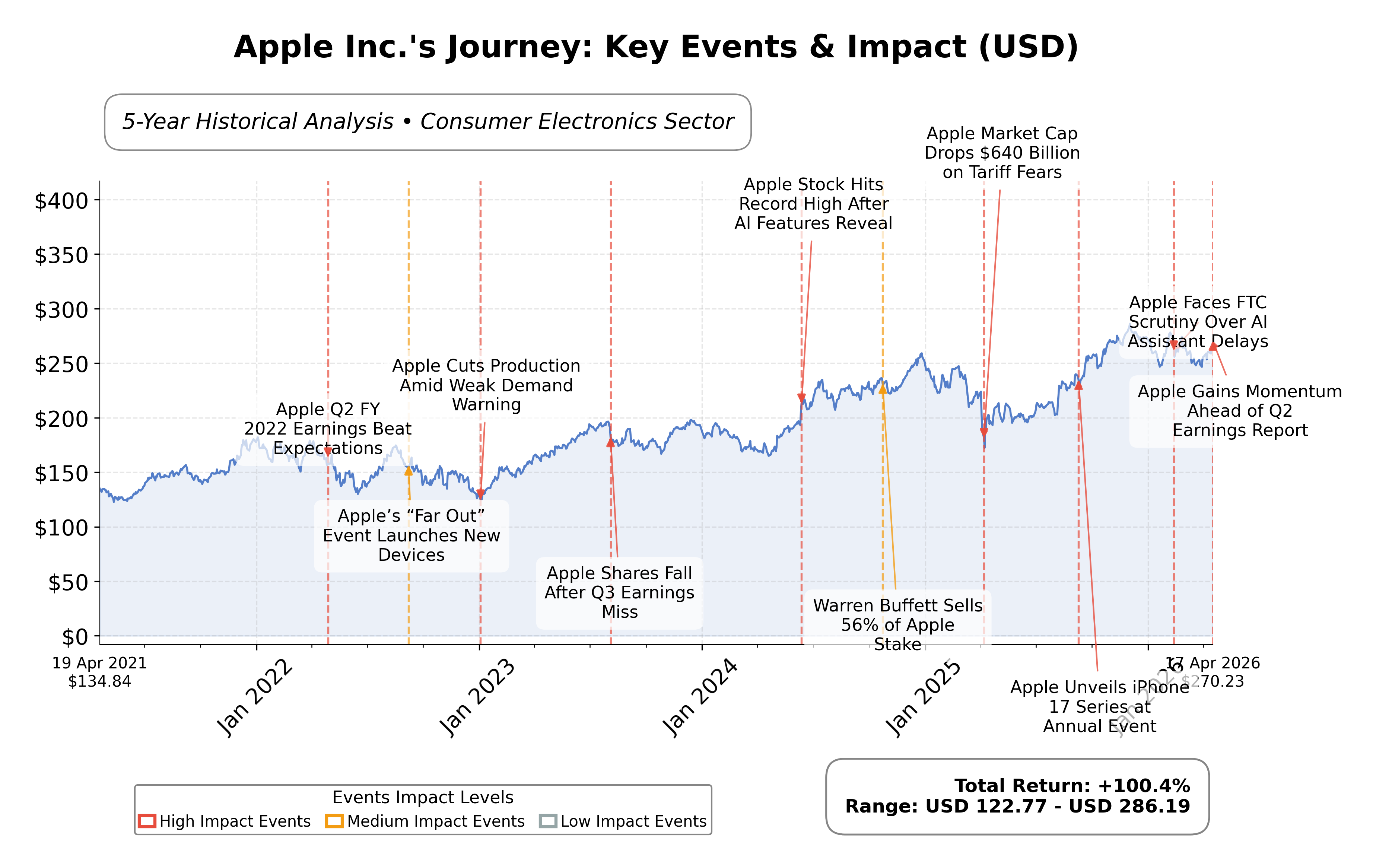
Key Positives and Key Risks
Pros
- Strong revenue growth of 15.7% year-over-year indicates robust demand and expansion.
- Free cash flow of $106.3 billion demonstrates excellent cash generation and financial flexibility.
- Market capitalization near $4 trillion reflects dominant industry position and investor confidence.
Cons
- High price-to-book ratio of 45.05 suggests the stock is trading at a significant premium to book value.
- Debt-to-equity ratio of 102.63 indicates elevated leverage levels that could impact financial stability.
- Return on equity of 1.52% is relatively low compared to typical industry benchmarks, signaling potential efficiency concerns.
Disclosure: This information is for general awareness and does not constitute investment advice
Report Summary
Apple Inc. is a leading technology company listed on the NASDAQ exchange, operating primarily in the consumer electronics sector. The company designs, manufactures, and markets a broad range of innovative hardware products including the iPhone, Mac computers, iPad tablets, and Apple Watch, complemented by a suite of digital services such as the App Store, Apple Music, and iCloud. Apple’s market positioning is strong, with a significant global presence supported by retail stores, online platforms, and partnerships with carriers and resellers. Its integrated ecosystem and focus on seamless user experience have established it as a dominant player in the technology industry.
Financially, Apple reported trailing twelve months (TTM) revenue of approximately $435.6 billion with a gross margin of 48.16%, an operating margin of 35.37%, and a net profit margin of 27.04%. The company’s return on equity (ROE) stands at 1.52%, while return on assets (ROA) is 24.38%, reflecting efficient asset utilization. Operating cash flow reached $135.5 billion TTM, with free cash flow of $106.3 billion, underscoring strong cash generation capabilities. These metrics indicate robust profitability and operational efficiency.
Apple’s valuation metrics show a trailing price-to-earnings (P/E) ratio of 34.25 and a forward P/E of 28.92, with a price-to-book (P/B) ratio of 45.05 and an enterprise value to EBITDA (EV/EBITDA) of 26.10. The market capitalization is approximately $3.97 trillion. The stock trades within a 52-week range of $189.81 to $288.62, with the current price of $270.19 positioned closer to the upper end, suggesting a relatively high valuation compared to historical lows but still below the peak.
Key strengths include Apple’s massive cash reserves of $66.9 billion, strong free cash flow, and dominant market leadership in consumer electronics and services. Risks involve regulatory scrutiny, competitive pressures in smartphones and services, and macroeconomic factors affecting consumer spending. Recent strategic initiatives include launching an integrated Apple Business platform and store closures that have sparked labor relations discussions. These actions reflect ongoing efforts to innovate and optimize operations.
Technically, Apple’s stock shows a positive trend supported by its position above the 50-day and 200-day moving averages, with momentum indicators reflecting moderate strength. Recent news highlights strong revenue growth and market share gains, particularly in China. Overall, the data suggests a balanced environment where accumulation or cautious monitoring may be appropriate given valuation levels and market dynamics.
Company and Industry Overview
Company Basics
Price Performance
Company Size
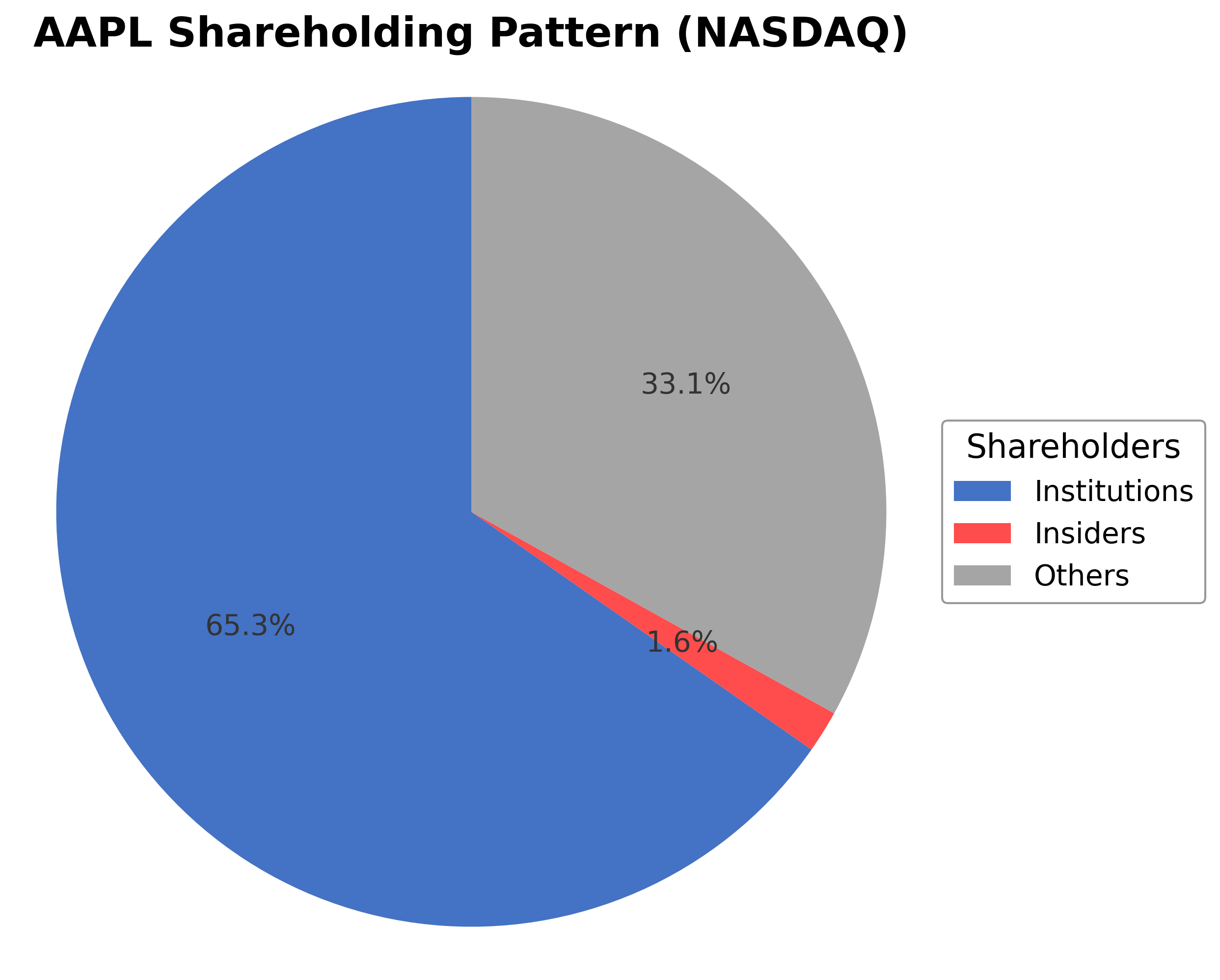
Shareholding Pattern
Sector and Industry Analysis
The technology sector, particularly the hardware and consumer electronics segment, represents a multi-trillion-dollar global market characterized by steady growth driven by innovation and consumer demand. Major players include Apple, Samsung, and Huawei, with Apple holding a significant market share due to its integrated ecosystem of hardware and software products. The sector benefits from continuous advancements in semiconductor technology, mobile computing, and digital services, fueling expansion in both mature and emerging markets.
Within the hardware industry, trends emphasize ecosystem integration, with companies like Apple leveraging proprietary software and custom silicon to differentiate their offerings. Competitive dynamics are shaped by high barriers to entry, including substantial R&D investment, supply chain complexity, and brand loyalty. Firms increasingly focus on expanding services such as streaming, subscriptions, and augmented reality to diversify revenue streams beyond traditional device sales, intensifying competition around innovation and user experience.
The regulatory environment for technology hardware companies involves data privacy, intellectual property rights, and international trade policies, which can affect supply chains and market access. Compliance with privacy laws such as GDPR and evolving antitrust scrutiny influences product design and business practices. Ongoing geopolitical tensions and export controls, especially concerning semiconductor technology, present challenges and uncertainties that companies must navigate to maintain global operations and growth.
Note: Analysis synthesized from industry research, market reports, and regulatory filings. Information is subject to change based on market conditions.
Financial Ratios Dashboard
Illustrative Scenario Analysis
DCF Assumptions:
Method: Two-Stage EPS-Priority Model
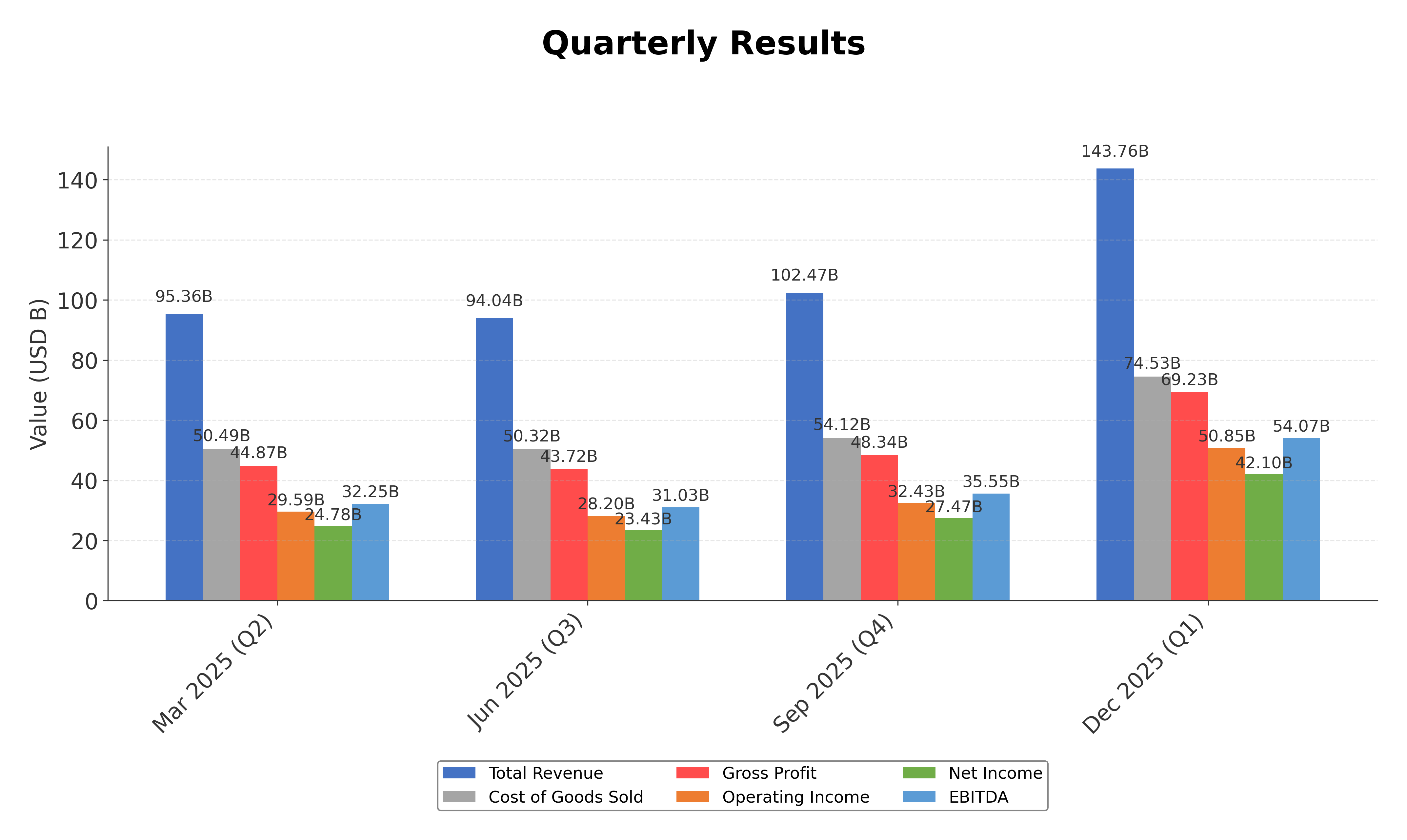
Financials
Peer Analysis
| Company Name | Market Cap | P/E Ratio | P/B Ratio | EV/EBITDA | Price to CFO |
|---|---|---|---|---|---|
| Apple Inc. | $3.97T | 34.25 | 45.05 | 26.10 | 29.32 |
| Sony Group Corporation - Sponsored American Depositary Receipt | $124.34B | 16.19 | 2.44 | 0.03 | 9.60 |
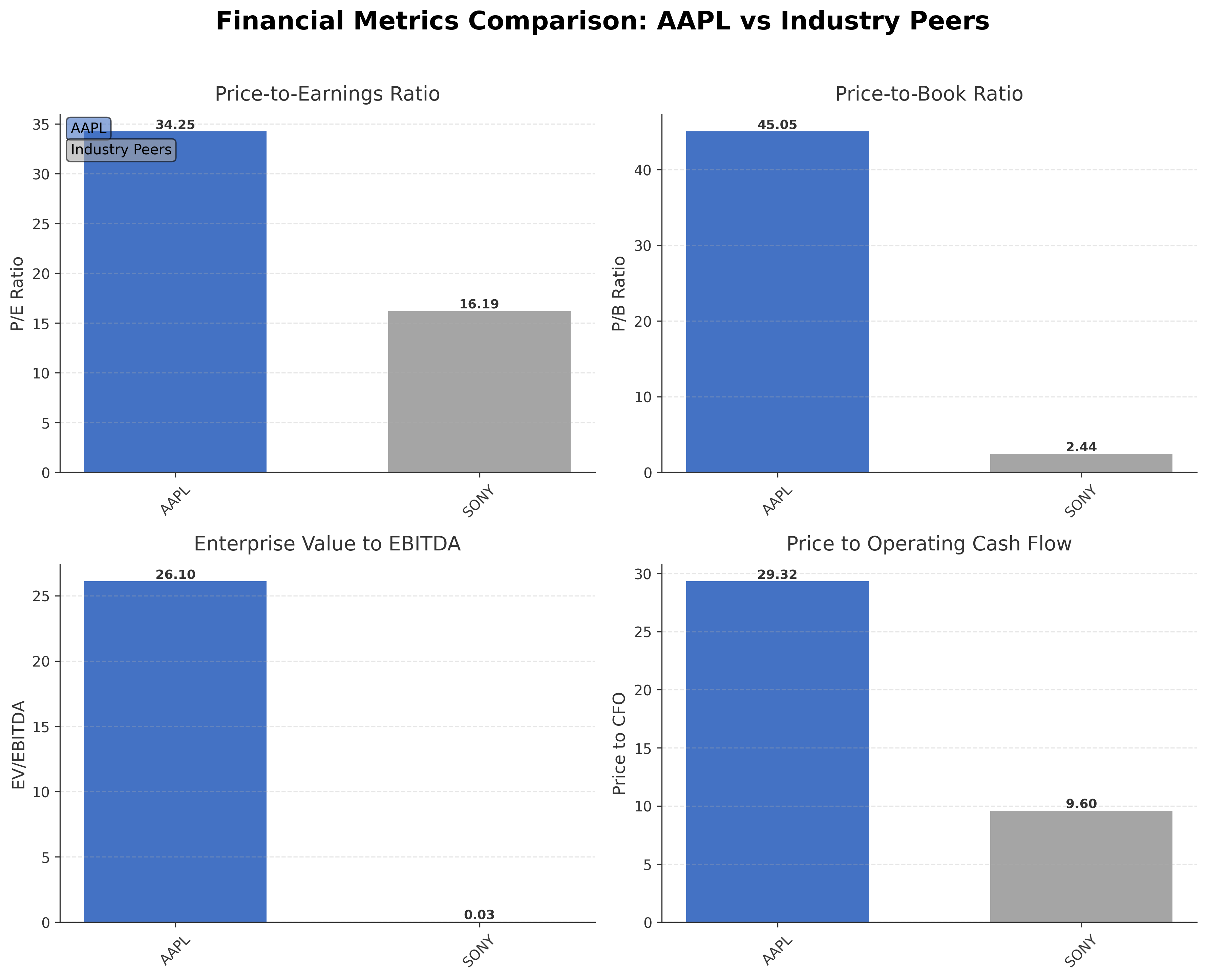
Comparison Analysis: Apple Inc. significantly outpaces its peer Sony Group Corporation in market capitalization, reflecting its dominant industry position with a $3.97 trillion valuation compared to Sony's $124.34 billion. Apple’s P/E ratio of 34.25 is more than double Sony’s 16.19, indicating a higher valuation premium possibly due to stronger growth expectations and profitability. The P/B ratio for Apple is substantially higher at 45.05 versus Sony’s 2.44, highlighting market perceptions of Apple’s intangible assets and brand value. Apple’s EV/EBITDA of 26.10 contrasts sharply with Sony’s 0.03, suggesting differences in earnings and capital structure. Return on equity for Apple at 1.52% also exceeds Sony’s 0.15%, reflecting superior shareholder returns.
Financial Metrics Comparison with Peers
Financial Statements
Comprehensive financial data including income, balance sheet, and cash flow metrics
Income Statement
| fiscal_date | 2025-09-30 | 2024-09-30 | 2023-09-30 | 2022-09-30 | 2021-09-30 |
|---|---|---|---|---|---|
| Sales | 416.16B | 391.04B | 383.29B | 394.33B | 365.82B |
| Cost Of Goods | 220.96B | 210.35B | 214.14B | 223.55B | 212.98B |
| Gross Profit | 195.20B | 180.68B | 169.15B | 170.78B | 152.84B |
| Operating Expense Research And Development | 34.55B | 31.37B | 29.91B | 26.25B | 21.91B |
| Operating Expense Selling General And Administrative | 27.60B | 26.10B | 24.93B | 25.09B | 21.97B |
| Operating Income | 133.05B | 123.22B | 114.30B | 119.44B | 108.95B |
| Other Income Expense | -321.00M | 269.00M | -565.00M | -334.00M | 60.00M |
| Pretax Income | 132.73B | 123.48B | 113.74B | 119.10B | 109.21B |
| Income Tax | 20.72B | 29.75B | 16.74B | 19.30B | 14.53B |
| Net Income | 112.01B | 93.74B | 97.00B | 99.80B | 94.68B |
| Eps Basic | 7.49 | 6.11 | 6.16 | 6.15 | 5.67 |
| Eps Diluted | 7.46 | 6.08 | 6.13 | 6.11 | 5.61 |
| Basic Shares Outstanding | 14.95B | 15.34B | 15.74B | 16.22B | 16.70B |
| Diluted Shares Outstanding | 14.95B | 15.34B | 15.74B | 16.22B | 16.70B |
| Ebit | 133.05B | 123.22B | 114.30B | 119.44B | 111.85B |
| Ebitda | 144.75B | 134.66B | 125.82B | 130.54B | 123.14B |
| Net Income Continuous Operations | 112.01B | 93.74B | 97.00B | 99.80B | 94.68B |
| Non Operating Interest Income | N/A | N/A | 3.75B | 2.83B | 2.84B |
| Non Operating Interest Expense | N/A | N/A | 3.93B | 2.93B | 2.65B |
Data provided by Twelve Data
Balance Sheet
| fiscal_date | 2025-09-30 | 2024-09-30 | 2023-09-30 | 2022-09-30 | 2021-09-30 |
|---|---|---|---|---|---|
| Cash And Cash Equivalents | 35.93B | 29.94B | 29.96B | 23.65B | 34.94B |
| Accounts Receivable | 39.78B | 33.41B | 29.51B | 28.18B | 26.28B |
| Total Assets | 359.24B | 364.98B | 352.58B | 352.75B | 351.00B |
| Total Liabilities | 285.51B | 308.03B | 290.44B | 302.08B | 287.91B |
| Long Term Debt | 78.33B | 85.75B | 95.28B | 109.71B | 119.38B |
| Shareholders Equity | 73.73B | 56.95B | 62.15B | 50.67B | 63.09B |
Data provided by Twelve Data
Cash Flow Statement
| fiscal_date | 2025-09-30 | 2024-09-30 | 2023-09-30 | 2022-09-30 | 2021-09-30 |
|---|---|---|---|---|---|
| Operating Activities Net Income | 112.01B | 93.74B | 97.00B | 99.80B | 94.68B |
| Operating Activities Depreciation | 11.70B | 11.45B | 11.52B | 11.10B | 11.28B |
| Operating Activities Stock Based Compensation | 12.86B | 11.69B | 10.83B | 9.04B | 7.91B |
| Operating Activities Other Non Cash Items | -89.00M | -2.27B | -2.23B | 1.01B | -4.92B |
| Operating Activities Accounts Receivable | -7.03B | -5.14B | -417.00M | -9.34B | -14.03B |
| Operating Activities Accounts Payable | 902.00M | 6.02B | -1.89B | 9.45B | 12.33B |
| Operating Activities Other Assets Liabilities | -18.87B | 2.77B | -4.27B | 1.57B | -1.53B |
| Operating Activities Operating Cash Flow | 111.48B | 118.25B | 110.54B | 123.52B | 100.94B |
| Investing Activities Capital Expenditures | -12.71B | -9.45B | -10.96B | -10.71B | -11.09B |
| Investing Activities Purchase Of Investments | -24.41B | -48.66B | -29.51B | -76.92B | -109.56B |
| Investing Activities Sale Of Investments | 53.80B | 62.35B | 45.51B | 67.36B | 106.48B |
| Investing Activities Other Investing Activity | -1.48B | -1.31B | -1.34B | -2.09B | -385.00M |
| Investing Activities Investing Cash Flow | 15.20B | 2.94B | 3.71B | -22.66B | -14.58B |
| Financing Activities Long Term Debt Issuance | 4.48B | 0.00 | 5.23B | 5.46B | 20.39B |
| Financing Activities Long Term Debt Payments | -10.93B | -9.96B | -11.15B | -9.54B | -8.75B |
| Financing Activities Short Term Debt Issuance | -2.03B | 3.96B | -3.98B | 3.96B | 1.02B |
| Financing Activities Common Stock Repurchase | -90.71B | -94.95B | -77.55B | -89.40B | -85.97B |
| Financing Activities Common Dividends | -15.42B | -15.23B | -15.03B | -14.84B | -14.47B |
| Financing Activities Other Financing Charges | -6.07B | -5.80B | -6.01B | -6.38B | -5.58B |
| Financing Activities Financing Cash Flow | -120.69B | -121.98B | -108.49B | -110.75B | -92.25B |
| End Cash Position | 35.93B | 29.94B | 30.74B | 24.98B | 35.93B |
| Income Tax Paid | 43.37B | 26.10B | 18.68B | 19.57B | 25.39B |
| Free Cash Flow | 98.77B | 108.81B | 99.58B | 111.44B | 92.95B |
| Interest Paid | N/A | N/A | 3.80B | 2.87B | 2.69B |
| Operating Activities Deferred Taxes | N/A | N/A | N/A | 895.00M | -4.77B |
| Investing Activities Net Acquisitions | N/A | N/A | N/A | -306.00M | -33.00M |
| Financing Activities Common Stock Issuance | N/A | N/A | N/A | N/A | 1.10B |
Data provided by Twelve Data
Technical Analysis
Key Insights
- Apple’s stock is currently in an upward trend, trading near its 52-week high with price action showing relative strength and moderate volatility.
- Key support levels are identified near $260 and $252, while resistance is observed around the recent high of $288.62.
- The stock price is above the 10-day, 50-day (approximately $260.69), and 200-day (approximately $251.83) moving averages, indicating a bullish medium-to-long-term trend.
- Momentum indicators show a Relative Strength Index (RSI) in the mid-60s, MACD positive but converging, and Stochastic oscillators indicating moderate momentum without overbought conditions.
- Multi-timeframe analysis reveals consistent bullish momentum on daily and weekly charts, with monthly trends supporting sustained upward movement.
- Current technical setup suggests potential continuation of the upward trend with caution warranted near resistance levels, while a break below support could signal consolidation.
Trending News
1. Headline: Can Apple Stock Thrive in the AI Revolution Despite Market Challenges?
Summary: Despite the focus being on AI in the news, Apple's engine continues to run at full speed. In its most recent quarter, Apple reported an increase in revenues by 16% or approximately $144 billion, with earnings per share increasing 19% or $2.84.
Sentiment: positive
2. Headline: Apple Stock (AAPL) Opinions on China iPhone Shipments Surge and Analyst Upgrades | AAPL Stock News
Summary: China Surge: Social media discussions spotlight a remarkable 20% jump in Apple iPhone shipments in China during the first quarter, defying a broader 4% market slump. Participants highlight Apple's capture of 19% market share, edging close to Huawei's lead. This unexpected strength has sparked ...
Sentiment: positive
3. Headline: There Is Incredible News for Apple Investors. Will It Be Enough to Send the Stock Higher? | The Motley Fool
Summary: In the first quarter, iPhone shipments increased despite a dip in overall smartphone shipments. Apple could further boost its smartphone market share by adding new AI features. The company's control over the supply chain should ensure it continues to outperform its peers. Apple's (AAPL +2.59%) share price has been somewhat volatile but essentially flat (down 0.6%) so far in 2026. The tech giant's tepid returns can be attributed to the broader negativity about tech stocks ...
Sentiment: positive
4. Headline: Tech stocks today: Tech sector trades at record highs, Figma stock slides after Anthropic releases Claude Design
Summary: Live coverage of "Magnificent Seven" stocks, and the latest technology news.
Sentiment: negative
5. Headline: Apple stock sees stunning Wall Street twist before earnings | AAPL - TheStreet
Summary: Bank of America thinks that Apple will announce another big buyback and a dividend increase, which will give investors even more reason to be positive. For shareholders, the report is not just another analyst note. This shows that one big Wall Street firm thinks Apple stock might still have ...
Sentiment: positive
Powered by Brave
Recent Updates
News Summary
As of 2026-04-14. Apple has launched a new all-in-one Apple Business platform that consolidates several existing business-focused products, including Apple Business Essentials, Apple Business Manager, and Apple Business Connect. This integrated platform aims to streamline device management, email, and customer engagement for enterprise customers, enhancing Apple's position in the business market. Additionally, Apple announced the closure of three retail stores by June 11, including its first-ever unionized location opened in 2022, sparking claims of union-busting and highlighting tensions in labor relations. These developments reflect Apple's strategic focus on enterprise solutions and operational adjustments in its retail footprint.
News Sentiment
The overall sentiment from recent updates is cautiously positive. The launch of the integrated Apple Business platform demonstrates innovation and a strategic push into enterprise markets, which is viewed favorably. However, the store closures, particularly of the unionized location, introduce some negative perceptions related to labor relations. The balance of these events suggests a company actively managing growth opportunities while navigating operational challenges.
Source List
- https://www.macrumors.com/2026/04/14/apple-business-platform-launches/
- https://www.foxbusiness.com/lifestyle/apple-closing-3-stores-including-its-first-ever-unionized-location-sparking-union-busting-claims
Analytical Overview
Analysis Summary
Apple’s valuation metrics, including a trailing P/E of 34.25 and forward P/E of 28.92, are elevated relative to the consumer electronics industry average P/E of 34.25, reflecting premium pricing consistent with its market leadership and growth prospects. The company’s revenue growth of 15.7% year-over-year and strong operating cash flow trends demonstrate a robust growth trajectory supported by solid demand for its products and services. Financial health is marked by a total debt to equity ratio of 102.63 and substantial cash reserves of $66.9 billion, indicating balanced leverage and strong liquidity. Sector-specific challenges include competitive pressures in smartphones and regulatory scrutiny, while opportunities arise from expanding services and AI integration. Market positioning and competitive advantages are underscored by Apple’s ecosystem and brand strength.
Overall Business and Market Assessment
Supporting Factors: Apple’s strong revenue growth of 15.7%, impressive free cash flow generation exceeding $106 billion, and dominant market capitalization of nearly $4 trillion
Risk Factors: No data
SWOT Analysis
Strengths
- Market leadership in consumer electronics with a strong global brand.
- Robust cash flow generation and substantial cash reserves.
- Integrated ecosystem of hardware, software, and services enhancing customer loyalty.
- Strong revenue growth and profitability metrics.
Weaknesses
- High valuation multiples relative to industry peers.
- Significant debt levels with a debt-to-equity ratio above 100%.
- Dependence on iPhone sales for a large portion of revenue.
- Limited diversification outside core technology products and services.
Opportunities
- Expansion of services and subscription-based offerings.
- Growth potential in enterprise solutions with new business platform.
- Increased market share in emerging markets such as China.
- Integration of AI features across product lines.
Threats
- Regulatory scrutiny and potential antitrust actions.
- Intense competition in smartphones and consumer electronics.
- Macroeconomic factors affecting consumer spending.
- Labor relations challenges including unionization efforts.
Company Description
Apple Inc. is a leading technology company renowned for designing, manufacturing, and marketing innovative hardware and software products for consumers and businesses worldwide. Its flagship product, the iPhone, accounts for the majority of sales, serving as the central hub of an expansive ecosystem that includes Mac computers, iPad tablets, Apple Watch wearables, and accessories like AirPods. Apple Inc. also offers a suite of services such as the App Store, Apple Music, iCloud, Apple TV+, and Apple Fitness+, providing digital content, cloud storage, and subscription-based platforms. Operating in the consumer electronics industry within the technology sector, the company employs approximately 166,000 people and maintains a broad global presence through online stores, retail outlets, and partnerships with carriers and resellers. With a substantial market capitalization reflecting its scale, Apple Inc. plays a pivotal role in shaping consumer technology trends, emphasizing seamless integration across devices and services to enhance user experience and productivity.